59 Best Things to Do in Sedona, Arizona (2026 Guide)
- Home
- Travel Tips
- 59 Best Things to Do in Sedona, Arizona (2026 Guide)
59 Best Things to Do in Sedona, Arizona (2026 Guide)

Easy & Secure Booking with Boletoxpress
This guide uses 1991 to 2020 climate normals from NOAA. We checked fees, hours, and closures in October 2026, and they can change, so confirm with the Coconino National Forest, Arizona State Parks, or the National Park Service before you go.
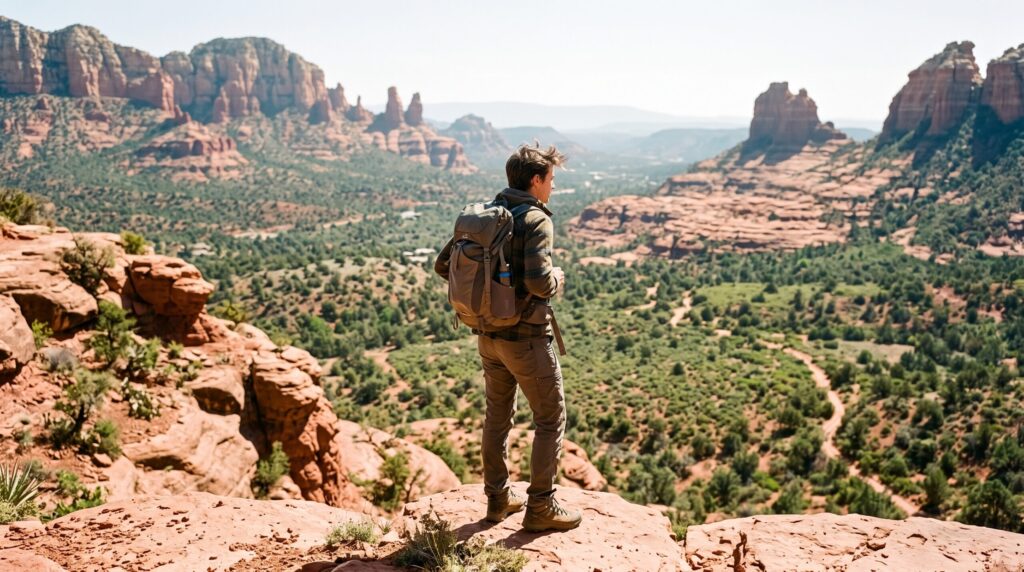
Sedona is located in northern Arizona, a 2-hour drive from Phoenix and a 45-minute drive from Flagstaff. Sedona’s buttes are made of red rock, and more than 300 miles of hiking trails start right there. In 2014, Sedona was named the 8th International Dark Sky Community. This land also holds historical importance for Indigenous people. This travel guide highlights 59 of the best things to do in Sedona, Arizona, from red rock hikes and trails to creek walks and starry nights.
What are the best things to do in Sedona?
Some of the most interesting activities in Sedona include hiking Devil’s Bridge, climbing Cathedral Rock, hiking Soldier Pass, visiting the Chapel of the Holy Cross, swimming at Slide Rock State Park (if it is open), and stargazing under dark skies.
Here’s a quick overview of the top attractions in Sedona to help you decide where to go first.
If you want | Our pick |
The famous arch photo | Devil’s Bridge |
A steep climb with a big view | Cathedral Rock |
An easy walk past huge red rocks | Bell Rock Pathway |
A sinkhole, rock pools and a cave | Soldier Pass |
A calm, free stop | Chapel of the Holy Cross |
A creek swim and natural slide | Slide Rock State Park |
Cliff dwellings | Montezuma Castle |
Dark skies | Stargazing |
If you have one morning, we would spend it at Soldier Pass or Devil’s Bridge. Both are must-do things in Sedona, and both give you more scenery per hour than anything in Uptown at midday.
Sedona Fire and Flood Update
Conditions around Sedona changed this year, so read this before you pick a trail.
The Pocket Fire broke out on June 19, 2026, roughly 7 miles north of Sedona. The fire scorched 27,393 acres and was finally contained on July 30. State Route 89A in Oak Creek Canyon remained closed for close to a month. In July, the Forest Service closed trails including Devil’s Bridge, Soldier Pass, and Boynton Canyon. The city restored Sedona Shuttle service to Dry Creek Vista, Mescal, and Soldier Pass on July 31.
The Forest Service reopened the creek and almost all other recreation sites the week of September 14. Slide Rock State Park’s swim area reopened September 17. Still, officials urge visitors to stay out of the water after storms, and Arizona State Parks has at times listed it as closed due to elevated water levels. The picnic area and a short nature trail are available. Check the park page on the day you go.
West Fork of Oak Creek is still closed. Forest Order 03-04-00-26-007 prohibits access to the West Fork drainage, West Fork Trail 108, and Call of the Canyon Picnic Area from September 26 to October 31, 2026. Violating this forest order is a Class B misdemeanor and carries a fine of up to $5,000 for an individual.
The smaller trails within the burn perimeter, such as Dry Creek, HS Canyon, Secret Canyon, Bear Sign, and David Miller, were closed through September 30. Check the Coconino National Forest alerts page for the current status, since that order may have been extended.
Rain still matters. On October 12 and 13, nearly 3 inches of rain in 48 hours flooded a bridge crossing at Cave Springs Campground in Oak Creek Canyon. About 65 campers were stranded until the water dropped. Do not go into creeks or washes when storms are near.
Do you need a Red Rock Pass in Sedona?
Often. Red Rock Pass lets you park at various trailheads for $5 a day, $15 a week, or $20 a year. The America the Beautiful Pass is another good option, and shuttle passengers at trailheads don’t need one.
The following trailheads require a pass: Baldwin, Bell Rock Pathway, Boynton, Cathedral Rock, Courthouse Butte, Doe Mountain, Dry Creek, Fay Canyon, Little Horse, Mescal, Midgley Bridge, Yavapai Vista, and Palatki, Honanki, and Crane Petroglyphs heritage sites. Attach the printed pass to your windshield, or purchase the online pass via Recreation.gov through your license plate number. You don’t need a pass for a brief photo stop of up to 15 minutes.
You can purchase park passes at site kiosks, the Sedona Chamber of Commerce Visitor Center (331 Forest Road), and the Red Rock Visitor Center (8375 State Route 179). Passes sold at the Visitor Centers are restricted to daily and weekly passes only; there is no annual pass available.
Other sites have their own fee schedule. The Coconino Annual Pass costs $50 and provides access to the Crescent Moon Picnic Site (Red Rock Crossing), Grasshopper Point, Call of the Canyon, Beaver Creek, and Lower Lake Mary. In May 2025, the Forest Service said concession site fees are separate from Red Rock Pass fees and proposed raising picnic site fees from $5 to $10 a day.
Each state or national park has different admission fees. Slide Rock, Red Rock State Park, Montezuma Castle, and Jerome State Historic Park all charge admission. However, Oak Creek Vista does not require a Red Rock Pass.
What is the weather like in Sedona, and how much does it rain?
Sedona weather is sunny and dry most of the year, with monsoon storms in July and August. Temperatures and rain use NOAA 1991 to 2020 climate normals for the Sedona station. Rain is the monthly average in inches. Data checked October 2026.
Month | Avg high | Avg low | Average rain | Best move |
January | 58°F | 34°F | 2.04 in | Cold starts, so hike at midday |
February | 61°F | 36°F | 2.17 in | Wettest month on average, so check trail conditions |
March | 67.5°F | 40°F | 1.94 in | Comfortable for long hikes |
April | 75°F | 44°F | 0.77 in | Easy hiking days, busy trails |
May | 84°F | 53°F | 0.68 in | Start early |
June | 94°F | 61°F | 0.16 in | Driest month, so hike at sunrise |
July | 97°F | 68°F | 1.62 in | Hottest month, so go at sunrise and rest at midday |
August | 94°F | 67°F | 2.04 in | Most rainy days, so check the forecast before any creek |
September | 89°F | 61°F | 1.72 in | Still warm, so go early |
October | 79°F | 51°F | 1.38 in | Strong month for all-day hikes |
November | 67°F | 41°F | 1.12 in | Cool, calm days |
December | 58°F | 33°F | 1.48 in | Bring layers for cold mornings |
Source: NOAA NCEI U.S. Climate Normals, 1991 to 2020, Sedona, AZ. Annual rainfall averages about 17 inches.
What are the best hikes in Sedona?
Hiking is the top reason to visit Sedona. Trails range from simple red-rock paths to more challenging hikes. The following Sedona hiking guide chart shows which trails suit your physical condition and parking arrangements.
Attraction | Cost | Best For | Distance and climb | Getting there |
Devil’s Bridge | Red Rock Pass, or free by shuttle | The famous arch photo | 3.8 to 5.8 miles round trip, about 371 feet of climb | Shuttle Route 11 to Dry Creek Vista or Mescal, Thursday to Sunday |
Cathedral Rock | Red Rock Pass, or free by shuttle | Strong hikers who want a climb | 1.1 miles round trip, 669 feet of climb | Shuttle Route 15 from the Bowstring Park and Ride lot |
Bell Rock Pathway and Courthouse Butte Loop | Red Rock Pass | Families and first-timers | Pathway: 3.5 miles one way with 185 feet of change; loop 3.8 to 4.5 miles round trip | Start at Bell Rock Vista, Courthouse Vista, or Little Horse |
Soldier Pass | Free by shuttle; check the lot rules | A sinkhole, rock pools, and a cave | About 4 to 4.5 miles round trip, 600 to 850 feet of climb | Shuttle Route 14 runs when the trailhead lot is closed; check the official schedule for gate hours. |
Boynton Canyon | Red Rock Pass | Quiet canyon walks and Kachina Woman | About 6 miles out and back on the main trail | The lot holds about 35 cars, so arrive early |
Sugarloaf Loop Trail | Not on the Red Rock Pass list; confirm at the trailhead | Easy views close to town | Just under 2 miles, loop | Trailhead in West Sedona; cairns mark the way |
Devil's Bridge Trail
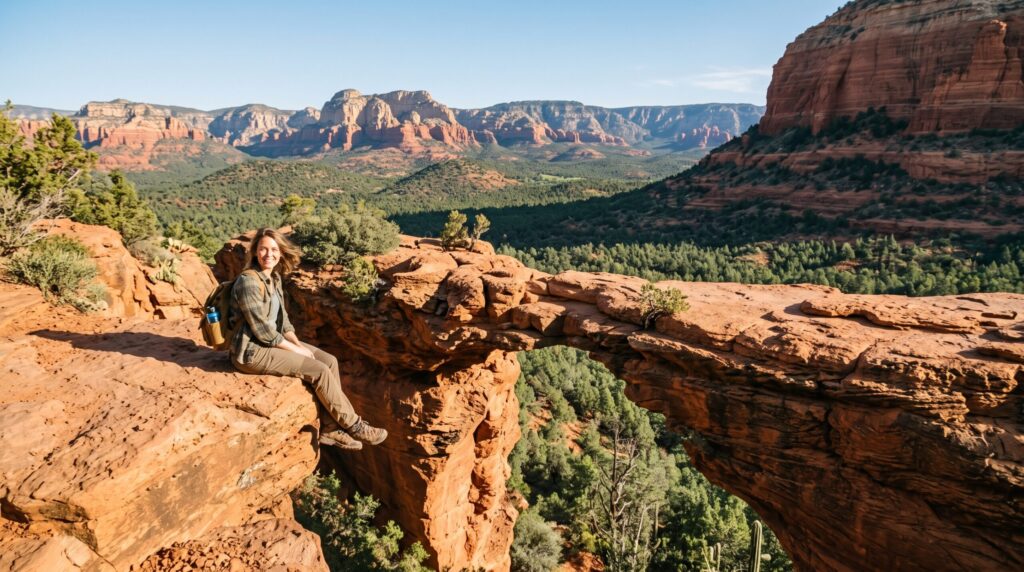
The Forest Service says Devil’s Bridge is the largest natural sandstone arch in the Sedona region. The Devil’s Bridge Trail is Forest Trail No. 120. The trailhead is 4,605 feet above sea level, with an elevation gain of about 371 feet.
Trail length varies depending on parking point. The Forest Service estimates a 5.8-mile round trip from Dry Creek Vista, while Arizona Highways estimates 3.8 miles from Mescal Trailhead. The unpaved road to the nearest trailhead requires a high-clearance vehicle, so most people park elsewhere.
The path is easy at first. Near the end, you climb sandstone steps and walk a short way along the rock wall to the arch. Lines to pose on top get long as the day goes on. We recommend the shuttle, since the Route 11 service from the West SR 89A Park & Ride takes you to the Dry Creek Vista and Mescal trails. Shuttle service begins at 7 a.m.; therefore, visiting at dawn means driving to Mescal Trail between Monday and Wednesday.
Our take: if you do one famous hike, make it this one. It asks less of your legs than Cathedral Rock and gives you the arch.
Cathedral Rock Trail

The Forest Service calls Cathedral Rock Trail No. 170 more of a rock climb than a hike. It considers the hike strenuous: 1.1 miles round trip, a 669-foot elevation gain, starting from a trailhead at 4,043 feet. There is no shade available. The trail is cairned over barren rock surfaces, and some footholds have been chipped into the rock.
Bring hiking boots and pack drinking water, even for a short hike. Cathedral Rock is also a popular energy vortex and a favorite spot for sunrise and sunset.
The hardest part is finding parking. When the shuttle is operating, personal vehicles cannot park in the Cathedral Rock area. Follow Route 15 from the Bowstring Park and Ride lot. Otherwise, the parking area is open, but overnight camping is not allowed. For sunset hikes, carry a headlamp on the return.
Bell Rock Pathway and Courthouse Butte Loop
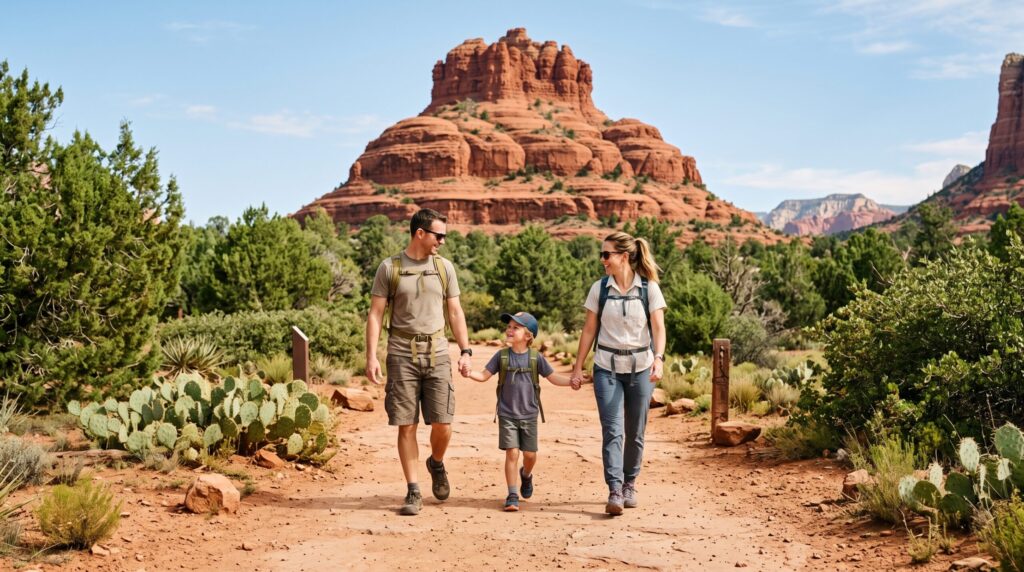
Bell Rock Pathway is Forest Trail No. 96. The Forest Service calls it an easy, family-friendly trail that runs 3.5 miles one way with 185 feet of elevation change. A typical round-trip hike to the rock takes about 2.5 hours. Restrooms are at the north and south trailhead lots.
This trail can be accessed from Bell Rock Vista or Courthouse Vista on SR 179. The trail ends at the Little Horse Trailhead and may be a great starting point if the Bell Rock parking lot is full.
Looking for peace? Take the Courthouse Butte Loop, Trail No. 135. The Forest Service lists it at 3.8 miles round trip. Arizona Highways gives 4.5 miles if you begin at Bell Rock Vista. The loop includes part of the Munds Mountain Wilderness, designated in 1984 to protect Bell Rock and Courthouse Butte.
The Baby Bell, Llama and Bail Loop is another 3.6-mile option near Bell Rock and Courthouse Butte. Our take: this is the best pick for anyone who wants big red rock views without scrambling.
Soldier Pass: Devil's Kitchen, Seven Sacred Pools and Soldier Pass Cave
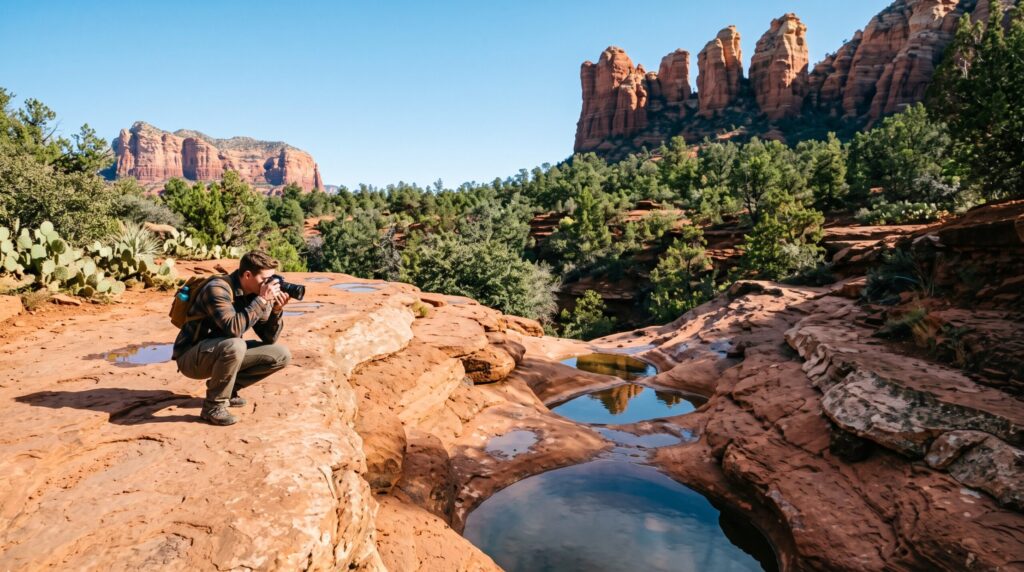
Soldier Pass Trail No. 66 packs three stops into one hike. After about two-tenths of a mile, you reach Devil’s Kitchen, a large sinkhole formed around the 1880s. Half a mile later, you’ll reach the Seven Sacred Pools. These sandstone pools look different after rainfall.
Beyond the Seven Sacred Pools, you’ll ascend to Soldier Pass Cave, which has two levels and an entrance point overlooking the valley.
Guides list the full trip at about 4 to 4.5 miles round trip with roughly 600 to 850 feet of gain, and 2.5 to 4 hours of hiking. The range depends on how far you go past the cave.
Crowds are heavy at the sinkhole and pools, especially on weekends. The trailhead lot is closed when the shuttle is running, so check the schedule ahead of time. We would go on a weekday morning and arrive shortly before the 8 a.m. gate opens.
Boynton Canyon, Kachina Woman and Subway Cave
Boynton Canyon lies northwest of Sedona in the Red Rock Secret Mountain Wilderness. The Yavapai-Apache Nation considers Boynton Canyon sacred. The main trail in Boynton Canyon is 6 miles round trip and starts at the Enchantment Resort boundary.
Two spurs make this a flexible outing. The Boynton Vista spur ends at the base of Kachina Woman, a tall red spire many people name as a vortex site, and is a little over a mile round trip. The Subway Cave side trail splits off from the main trail after two miles and continues for 0.4 miles to a large cave. The main trail takes 2.5 to 4 hours, while the cave trail takes 4 to 6 hours.
Sugarloaf Loop Trail
The Sugarloaf Loop Trail is an easy trail in West Sedona that is less than two miles long. Along the way, you get views of Capitol Butte and Coffee Pot Rock. From the high point, you can also see Airport Mesa, Courthouse Butte, Bell Rock, and Cathedral Rock.
What are the best things to see in Sedona, AZ?
Not every great view needs a hike. If you are wondering what to see in Sedona, start with these viewpoints and sacred sites. They are the Sedona things to see when you have 15 minutes to an hour and want red rock scenery.
Attraction | Cost | Best for | Timing tip | Parking or walking |
Chapel of the Holy Cross | Free, donations welcome | Architecture and views | About 30 minutes for a quick stop | Small upper lot; walk up from the lower lots at busy times |
Airport Mesa | Check posted parking rates | Sunrise and sunset | Arrive about 45 minutes before sunset | Flat top with a loop trail |
Oak Creek Vista | No Red Rock Pass needed | A canyon view on the way to Flagstaff | 20 to 30 minutes | Short walk from parking |
Yavapai Vista Point | Red Rock Pass beyond a quick photo stop | Views from the car | 15 to 30 minutes | Roadside stop, little walking |
Midgley Bridge | Red Rock Pass beyond a quick stop | Photos at the canyon entrance | 15 minutes to an hour | Trailhead and photo spots nearby |
Amitabha Stupa and Peace Park | Check the official page | A calm, reflective stop | 30 to 60 minutes | Paths and benches |
Sedona vortex sites | Costs follow each site | Curious visitors | 30 minutes to a few hours | On trails and viewpoints covered above |
Chapel of the Holy Cross

This Roman Catholic chapel is built into the red rock cliffs at 780 Chapel Rd, Sedona, AZ 86336, and it is a must-see stop for its setting and views. Local sculptor and rancher Marguerite Brunswig Staude conceived and commissioned the chapel, which architects Richard Hein and August K. Strotz of Anshen & Allen designed and completed in 1956.
The parking lot at the top is small. Expect to walk up from the lower lots at busy times. Allow about 30 minutes for a quick stop. It pairs well with Bell Rock because both are on the south side of town. Check the official page for hours.
Airport Mesa
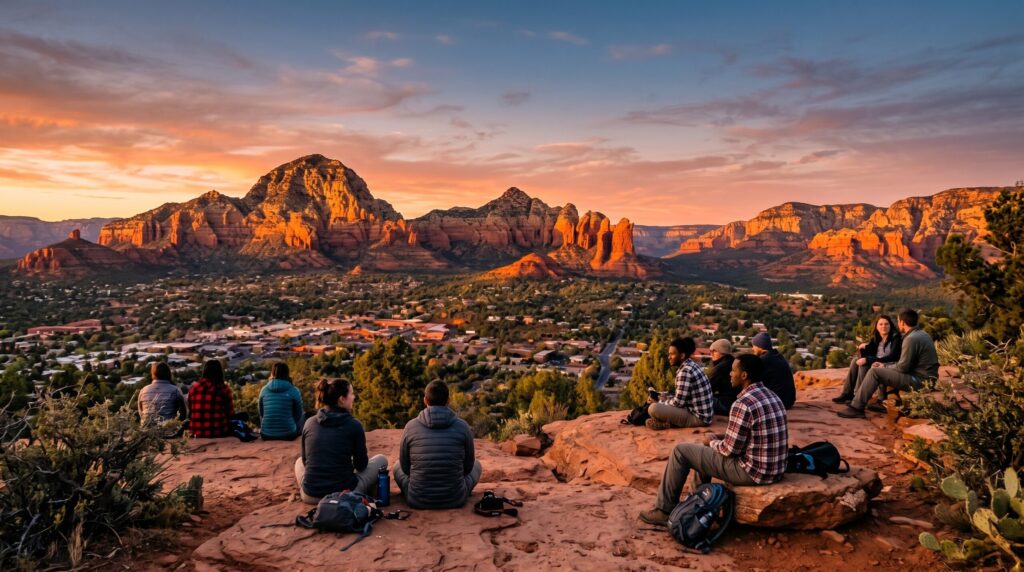
A flat, high spot close to town with wide views. A loop trail circles the mesa, and it’s also one of Sedona’s best-known vortex sites.
Come about 45 minutes before sunset to find a space. Airport Mesa or Cathedral Rock for sunset? Airport Mesa is easier, more accessible, and better with kids. Cathedral Rock has the better glow on the rock, but you climb in fading light.
Oak Creek Vista
Oak Creek Vista is an overlook on SR 89A at the top of Oak Creek Canyon, north of Sedona. It does not require a Red Rock Pass. Allow 20 to 30 minutes. It suits drivers heading to Flagstaff, visitors with limited mobility, families with strollers, and anyone who wants a canyon view without a hike. The drive up Oak Creek Canyon is scenic in its own right.
Yavapai Vista Point
Yavapai Vista Point is a roadside viewpoint on SR 179 with wide views over the red rock country. A Red Rock Pass is required for parking at the trailhead lot. Allow 15 to 30 minutes. It suits anyone who wants a view from the car.
Midgley Bridge
Midgley Bridge is a historic arch bridge on SR 89A at the entrance to Oak Creek Canyon, with a trailhead and photo spots nearby. A Red Rock Pass is required to park in the bridge lot. Allow 15 minutes to an hour. It is one of Sedona’s easiest photo spots and suits photographers and short walkers.
Amitabha Stupa and Peace Park
The Amitabha Stupa and Peace Park is a quiet Buddhist site in West Sedona with a stupa, paths, and benches. Check the official page for hours and any donation requests. Allow 30 to 60 minutes. It suits visitors who want a calm, reflective stop.
Sedona vortex sites
A spiritual vortex, also called an energy vortex, is a spot many visitors consider spiritually energetic. The most commonly named Sedona vortex sites are Airport Mesa, Cathedral Rock, Bell Rock, and Boynton Canyon. They sit on trails and viewpoints covered above, so costs follow those sites. Airport Mesa is the easiest choice for beginners. Allow 30 minutes to a few hours. They suit curious visitors and anyone seeking a quiet moment.
Where can you walk by the creek in Sedona?
Oak Creek is the other big draw in Sedona, Arizona, but this year’s fire and flood closures matter. Check the status column before you drive to any creek.
Attraction | Cost | Best for | Status or water access | Covered by |
Slide Rock State Park | Per vehicle, about $10 to $30 depending on season | The natural water slide | Confirm water access before you drive | State park fee; Red Rock Pass does not apply |
West Fork of Oak Creek | Concession fee, covered by the Coconino Annual Pass | Shaded creek walks, after it reopens | Closed through October 31, 2026 | Coconino Annual Pass |
Grasshopper Point | Day fee | Quiet creek visits | Confirm water access first | Coconino Annual Pass |
Crescent Moon Picnic Site | Day fee, or Coconino Annual Pass | Cathedral Rock reflections | Wading, fishing and picnics | Coconino Annual Pass |
Red Rock State Park | State park entry fee | Families, birders and easy walkers | 5 miles of trails along Oak Creek | State park fee |
Beaver Creek and Lower Lake Mary | Day fees apply without a pass | Picnics and fishing | Creek and lake sites | Coconino Annual Pass |
Slide Rock State Park
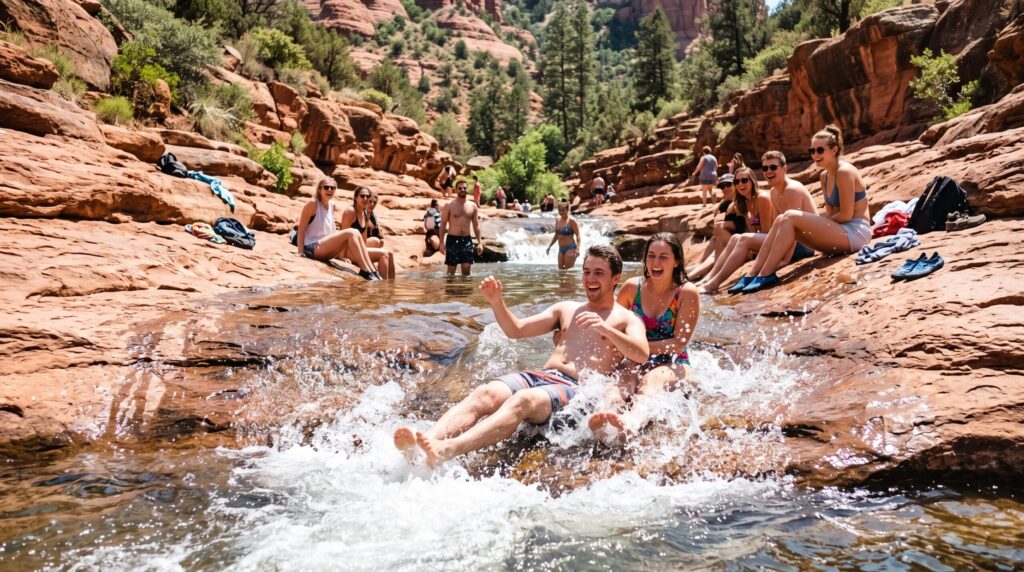
The park lies along SR 89A in Oak Creek Canyon, about 6 to 7 miles north of Sedona, on the historic Pendley Homestead apple farm.
The natural sandstone water slide is the draw, and the creek makes it a natural swimming hole in warm weather. Pets are not allowed from May 1 through September 30. Pay by Visa or Mastercard, or bring exact change in cash. Swimming is the thing to confirm this year, because the fire and flood closures hit this stretch of Oak Creek. Check the park page for water access before you go. The creek can rise fast after storms.
West Fork of Oak Creek (closed through October 31, 2026)
West Fork is a shaded canyon trail that follows a flowing creek, about 10 miles north of Sedona. Call of the Canyon is a concession site, so a Red Rock Pass does not cover it, but the Coconino Annual Pass does.
We wouldn’t drive out to West Fork before November, and even then only after checking the alerts page. If you want a shady, creek-side hike this fall, the closure is a good reason to choose a different trail.
Grasshopper Point
Grasshopper Point is a creek-side picnic area on Oak Creek, just north of Sedona on SR 89A. It is a concession site that has recently closed due to the Pocket Fire. The Coconino Annual Pass covers it. Allow 1 to 3 hours. It suits families and anyone after a quieter creek visit.
Crescent Moon Picnic Site (Red Rock Crossing)
Crescent Moon Picnic Site, also called Red Rock Crossing, is a beautiful picnic park on Oak Creek in West Sedona known for views of Cathedral Rock. It charges a day fee, and the Coconino Annual Pass covers it. Allow 1 to 2 hours. It suits photographers, picnickers, and sunset watchers.
Red Rock State Park
Red Rock State Park is a nature preserve on Oak Creek southwest of Sedona with short loop trails and a visitor center. It opened to the public on October 19, 1991, and charges an entry fee. Allow 1 to 3 hours. It suits families, birders, and easy walkers. Only service animals are allowed.
Beaver Creek and Lower Lake Mary
Beaver Creek, in the Verde Valley, and Lower Lake Mary, south of Flagstaff, are Coconino concession sites covered by the Coconino Annual Pass. Day fees apply without it. Allow a few hours at each. They suit picnickers, anglers, and visitors who want less crowded water.
Where can you shop and see art in Sedona?
Sedona is also an art town. Shopping and gallery browsing in Sedona are great ways to spend a slower day, with courtyards and film history nearby. This table shows how much time each stop needs.
Attraction | Cost | Best for | Time needed | Timing tip |
Tlaquepaque Arts and Shopping Village | Free to walk in; shops and meals extra | Courtyards, galleries and lunch | 1 to 2 hours | Shop hours change by store and season; holiday lights in December |
Sedona Arts Center | Browsing usually free, classes and events priced separately | Art lovers and hands-on visitors | 30 to 60 minutes | Check the events page |
Gallery Row on State Route 179 | Free to browse | Window shopping | 1 to 2 hours | Hours vary by gallery |
Hillside Sedona | Free to browse | Galleries without the Uptown crowds | About an hour | On-site parking |
Sedona Heritage Museum | Admission charged | Local and film history | About an hour | Check hours before you go |
Sedona International Film Festival | Priced per screening, passes available | Film fans | A day or a weekend | Confirm dates on the festival page |
Is winter a good time to visit Arizona?
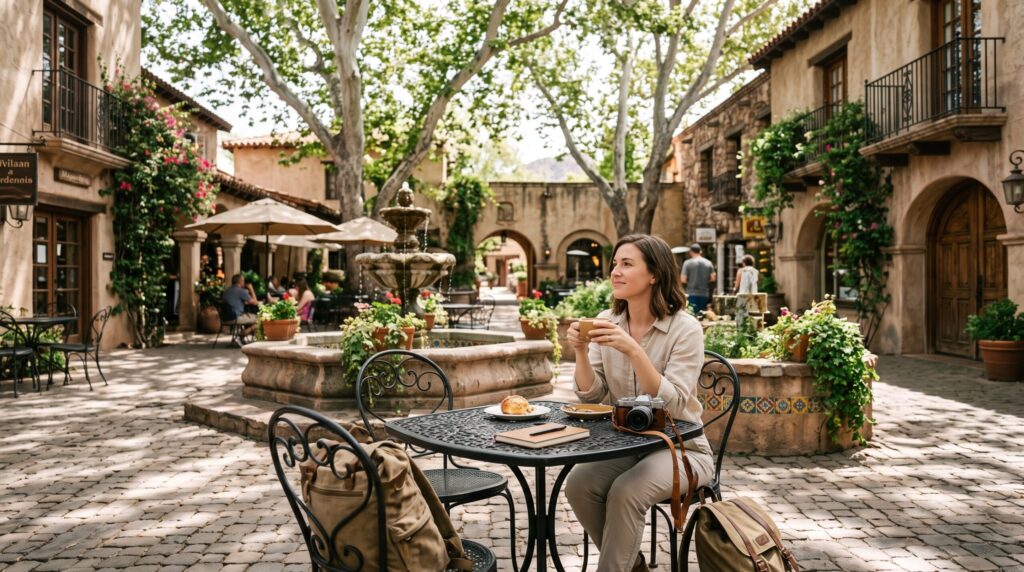
Say it as tla keh PAH keh. It is an open-air arts and crafts village styled after a Mexican village. Founder Abe Miller opened it in 1973 and named it for San Pedro Tlaquepaque near Guadalajara.
The village features more than 40 shops and galleries, plus courtyards, fountains, and a chapel Miller loved most. The builders worked around the sycamores, and one branch still arches over the walkways. Shop hours change by store and season, so check the official website or call ahead.
Try the Secret Garden Cafe for a casual stop. Courtyard dining here is mostly mid-range in price. Tlaquepaque also lists events throughout the year, including holiday lights in December.
Sedona Arts Center
The Sedona Arts Center is an arts hub in Sedona with galleries, classes, and events. Browsing is usually free, while classes and events are priced separately. Allow 30 to 60 minutes. It suits art lovers and hands-on visitors.
Gallery Row on State Route 179
Gallery Row runs along SR 179 in the south of Sedona, near Tlaquepaque. Browsing is free. Allow 1 to 2 hours. It suits art lovers and window shoppers.
Hillside Sedona
Hillside Sedona is a shopping and gallery complex on SR 179 with courtyards and on-site parking. Browsing is free. Allow about an hour. It suits shoppers who want galleries without the Uptown crowds.
Sedona Heritage Museum
The Sedona Heritage Museum sits on a historic farm site in Sedona and tells the story of the town’s pioneers, ranchers, and film history. Admission is charged. Allow about an hour. It suits history lovers and families.
Sedona International Film Festival
The Sedona International Film Festival screens films at theaters in West Sedona, usually in late winter. Tickets are priced per screening, with passes available. Allow a day or a weekend. It suits film fans. Confirm dates on the festival page.
What are the best ancient and historic sites near Sedona?
Explore cliff dwellings, rock art, and an old Army fort at these historic sites near Sedona. They also tell the story of the region’s Native American heritage, from the Sinagua to the Yavapai-Apache Nation. Palatki and Honanki lie west of Sedona, and the others are in the Verde Valley, about a 30- to 35-minute drive away. For Jerome, see the day trips below.
Attraction | Cost | Best for | Booking or access | Time needed |
Montezuma Castle, Montezuma Well and Tuzigoot | Entrance fee for ages 16 and up; one fee covers the Castle and Tuzigoot | Cliff dwellings and a hilltop pueblo | The Castle is viewed from a paved 1/3 mile loop, with no entry inside | About an hour at the Castle |
Palatki Heritage Site | Red Rock Pass plus a timed tour ticket | Rock art with a guided tour | Reservations required, tours limited to 14 people | About 1.5 hours |
Honanki Heritage Site | Red Rock Pass | Cliff dwellings and fewer crowds | No reservation, limited hours | About an hour |
V Bar V Heritage Site | Check the Forest Service page | A large petroglyph panel | Check the official page for open days | About an hour |
Fort Verde State Historic Park | State park fee; check the park page | A restored Army post | Three historic house museums and a visitor center | About an hour |
Montezuma Castle, Montezuma Well and Tuzigoot
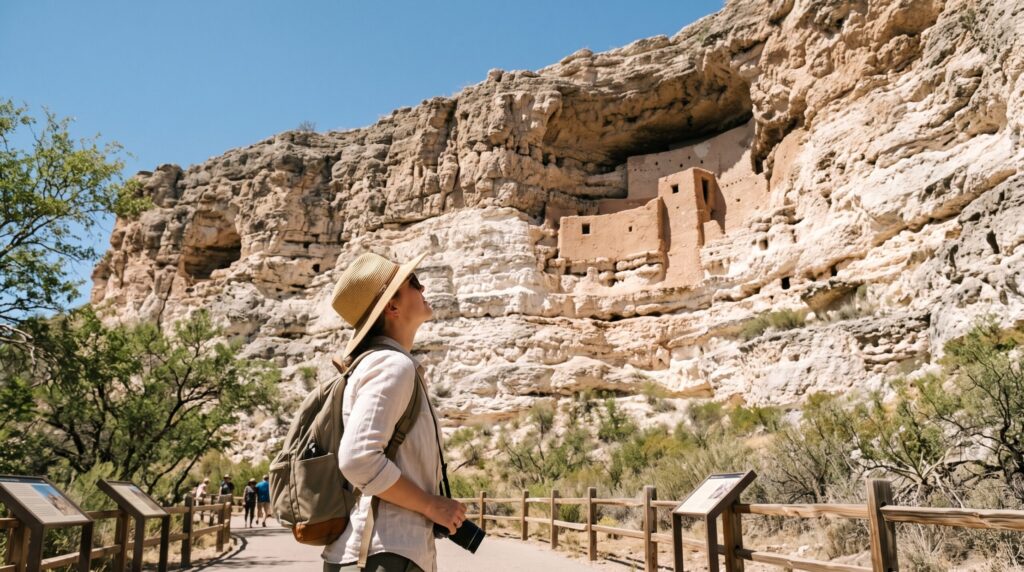
Montezuma Castle National Monument protects a cliff dwelling built by the Sinagua people, who lived along Beaver Creek for more than 400 years. The National Park Service says it became a national monument on December 8, 1906. Several Hopi clans trace their ancestry to the Sinagua, according to the Western National Parks Association. It was never connected to the Aztec emperor Montezuma. A paved 1/3 mile loop passes beneath the cliff, and most visitors need about an hour.
Montezuma Well is a limestone sinkhole and spring about 11 miles northeast of the Castle. More than 1.5 million gallons of water flow in each day. Dogs are welcome on the trails at the Castle and the Well, but not inside the Castle visitor center.
Tuzigoot is a pueblo on a hilltop above the Verde Valley with about 110 rooms, a museum, and a bookstore. A fire once closed the Tavasci Marsh trails, while the pueblo stayed open. Call ahead for the latest. Do the Castle and Tuzigoot on one ticket if you can. The Castle is about 50 miles south of Flagstaff and 90 miles north of Phoenix off Interstate 17.
Palatki Heritage Site
Palatki Heritage Site lies west of Sedona and protects Sinagua cliff dwellings and rock art. A Red Rock Pass applies, and a timed tour ticket is required. Tours are limited to 14 people and last about 1.5 hours. It suits history lovers and photographers.
Honanki Heritage Site
Honanki Heritage Site lies west of Sedona, near Palatki, and has Sinagua cliff dwellings and rock art. A Red Rock Pass applies. No reservation is needed, but hours are limited, so check the Forest Service page. Allow about an hour. It suits history lovers who want a quieter site.
V Bar V Heritage Site
V Bar V Heritage Site, also known as the Crane Petroglyph Heritage Site, is near Camp Verde and features a large panel of petroglyphs along Beaver Creek. Check the official page for fees and open days. Allow about an hour. It suits rock art fans.
Fort Verde State Historic Park
Fort Verde State Historic Park is in Camp Verde and preserves an Army post with restored buildings and exhibits. Arizona State Parks charges an entry fee. Allow about an hour. It suits history lovers and families.
Where can you stargaze in Sedona?
Sedona is a certified dark sky community, so stargazing is one of the easiest free things to do at night. This table shows where to go and what to plan around.
Attraction | Cost | Best for | Where | Plan around |
Two Trees observing area | Free | Beginners and families | West of Sedona off Highway 89A | New moon weeks are darkest |
Jordan Trailhead observing area | Free | A quieter option than Airport Mesa | In Sedona | Bring a red flashlight |
Boynton Pass Road | Free | Photographers and serious stargazers | Northwest of Sedona | Guides name it the darkest sky reachable by car |
Red Rock State Park star parties | Ticketed through Arizona State Parks | Beginners who want a guide | Southwest of Sedona | Register ahead |
Guided astronomy tours | Varies by operator | Beginners who want a telescope | Operators around Sedona | Clouds and storms can block the sky in July and August |
Stargazing in a Dark Sky Community

In 2014, the International Dark-Sky Association (now DarkSky International) named Sedona the world’s eighth International Dark Sky Community, according to the City of Sedona. Flagstaff was the first. Many visitors call Sedona a dark sky city, but its official title is International Dark Sky Community. The Milky Way core is visible from the edges of town on moonless nights in spring through early autumn.
Plan around the moon and the monsoon. New moon weeks are darkest. Clouds and storms can block the sky in July and August. Bring a red flashlight to protect your night vision. For astrophotography, a tripod, a wired shutter release, and a wide lens will do more for your photos than a fancy camera.
Two Trees observing area
Two Trees is an open field located west of town off Highway 89A near the intersection of Forest Road 525A and Forest Road 761B. Stargazing is free. Allow 1 to 2 hours after dark. It sits about 12 miles outside the city, reducing light pollution and making it a favorite meeting spot for local astronomy clubs.
Jordan Trailhead Observing Area
The Jordan Trailhead observing area is a Sedona spot guides recommend for night sky views. It is free. Allow 1 to 2 hours. It suits visitors who want a quieter alternative to Airport Mesa.
Boynton Pass Road
Boynton Pass Road, northwest of Sedona, is the spot guides call the darkest sky you can reach by car. It is free. Allow 1 to 2 hours. It suits photographers and serious stargazers.
Guided astronomy tours
Guided astronomy tours leave from operators around Sedona. Prices vary by operator. Allow 1.5 to 2 hours. They suit beginners who want a telescope and a guide.
Where should you eat and drink in Sedona?
Sedona dining spreads across a few areas, each with its own mood. Pick the area first, then pick the meal. For courtyard dining, see Tlaquepaque in the shopping section. Local places to check include Cowboy Club, Indian Gardens, Hideaway House, 89Agave Cantina, and Sedona Beer Company. Ask for a prickly pear margarita for a local twist, and confirm hours before you go.
Attraction | Cost | Best for | Good to know | Time needed |
Uptown Sedona | Budget to mid-range | First-time visitors | Parking fills at midday | 1 to 2 hours |
West Sedona | Varies widely | Families and relaxed meals | Easier parking than Uptown | 1 to 2 hours |
Village of Oak Creek | Mostly budget to mid-range | Hikers after a trail | Quieter, near Bell Rock | About an hour |
Old Town Cottonwood | Varies | Food lovers who want a change | Walkable main street | 2 to 3 hours |
Cornville and Verde Valley wineries | Tasting fees vary by winery | Adults who want a relaxed afternoon | Plan a sober driver | 1 to 3 hours |
Uptown Sedona
Uptown Sedona is the busy strip along SR 89A with casual restaurants and bars. Prices run from budget to mid-range. Allow 1 to 2 hours. It suits first-time visitors, though parking fills up at midday.
West Sedona
West Sedona runs along SR 89A west of the Y, with local restaurants and easier parking than Uptown. For a quirky photo stop, the McDonald’s at 2380 W. State Route 89A has turquoise arches, which some people call teal. It opened in May 1993, and the adjacent shopping center already used turquoise signs, according to Arizona Highways. Prices vary widely. Allow 1 to 2 hours. It suits families and anyone who wants a relaxed meal.
Village of Oak Creek
The Village of Oak Creek sits on SR 179 south of Sedona, near Bell Rock, with casual cafes and a quieter feel. Prices are mostly budget to mid-range. Allow about an hour. It suits hikers who want a meal after a trail.
Old Town Cottonwood
Old Town Cottonwood is about 30 minutes southwest of Sedona by car, with restaurants, tasting rooms, and shops on a walkable main street. Prices vary. Allow 2 to 3 hours. It suits food lovers who want a change from Sedona.
Cornville and Verde Valley wineries
Cornville and the wider Verde Valley have tasting rooms southwest of Sedona. A tour such as Sedona Vineyard Tours can handle the driving. Tasting fees vary by winery. Allow 1 to 3 hours. It suits adults who want a relaxed afternoon. Confirm hours and plan a sober driver.
How do you relax in Sedona?
After a long hike, Sedona offers spas, yoga, and sound baths. This table shows how much time each one takes.
Attraction | Cost | Best for | Time needed | Good to know |
Resort spas | Set by each resort, often higher-end | Unwinding | 1 to 3 hours | Book ahead |
Yoga and meditation sessions | Varies by instructor; drop-in classes usually cost less | Beginners and regulars | 1 to 2 hours | Indoors and outdoors |
Sound baths and bodywork | Varies by practitioner | A slow, restful break | About an hour | Sound baths use bowls and gongs |
Spiritual and intuitive readings | No standard rate | Curious visitors | 30 to 60 minutes | Choose a provider with clear, verified reviews |
Resort spas
Sedona resort spas offer massages, facials, and desert-themed treatments. Some wellness resorts double as spiritual retreats, and Sedona is widely known for spiritual and wellness travel. For lodging, upscale resorts such as Enchantment Resort, L’Auberge de Sedona, Amara Resort and Spa, and Hilton Sedona Resort at Bell Rock are popular choices for a spa weekend. Each resort sets its own prices, often at the higher end. Allow 1 to 3 hours. They suit travelers who want to unwind. Book ahead.
Yoga and meditation sessions
Sedona studios and guides offer indoor and outdoor yoga and meditation sessions. Prices vary by instructor, and drop-in classes usually cost less. Allow 1 to 2 hours. They suit beginners and regular practitioners
Sound baths and bodywork
Sound baths use bowls and gongs for relaxation, and bodywork includes massage, reiki, and energy sessions. Crystal shops are also easy to find in town. Prices vary by practitioner. Allow about an hour. They suit visitors who want a slow, restful break.
Spiritual and intuitive readings
Independent practitioners in Sedona offer spiritual and intuitive readings. Prices vary, with no standard rate. Allow 30 to 60 minutes. They suit curious visitors. Choose a provider with clear, verified reviews.
Which Sedona tours are worth booking?
If you would rather ride than hike, these Sedona activities cover backcountry roads, the sky, and the trails. Book a licensed operator and check the details in this table.
Attraction | Cost | Best for | Time needed | Good to know |
Jeep tours, including Broken Arrow | Varies by operator and route | Backcountry views without hiking | 1.5 to 3 hours | Book a licensed operator |
Hummer, ATV and UTV tours | Varies by operator and vehicle | Groups who want an active ride | About 2 hours | Check age and license rules |
Trolley and scenic bus tours | Varies by operator | Families and non-hikers | About an hour | Narrated ride |
Hot air balloon and helicopter tours | Among the most expensive options | Special occasions | 1 to 3 hours including transfers | Flights depend on weather |
Bike and electric bike tours and rentals | Priced by the hour, day, or tour | Fit riders and e-bike beginners | 2 to 4 hours | Some trails restrict bikes |
Guided hiking and photography tours | Varies by operator and length | First-time visitors and photographers | 2 to 5 hours | Small groups with a local guide |
Indigenous culture, vortex, wine and food tours | Vary widely | Themed outings | Varies | Choose a verified provider, and for Indigenous tours pick an operator led by or working with tribal members. |
Jeep tours, including Broken Arrow

Jeep tours and 4×4 off-road tours, including the Broken Arrow Trail to Chicken Point and Submarine Rock, take small groups over rocky trails in a modified vehicle. Pink Jeep Tours is one well-known operator. Chicken Point is a wide-open slickrock clearing and a favorite photo spot. Prices vary by operator and route. Most run 1.5 to 3 hours. They suit visitors who want backcountry views without hiking. Book with a licensed operator.
Hummer, ATV and UTV tours
Hummer, ATV and UTV tours are guided off-road outings around Sedona. Some operators also offer ATV rentals, and outfitters run horseback rides on guided trails. Prices vary by operator and vehicle. Most run about 2 hours. They suit groups who want an active ride. Check age and license rules before booking.
Trolley and scenic bus tours
Trolley and scenic bus tours give a narrated sightseeing tour through town and nearby red rock areas. Sedona Sightseeing Trolley is one local option. Prices vary by operator, and child fares are often lower. Allow about an hour. They suit families with young kids and visitors who prefer not to hike.
Hot air balloon and helicopter tours
A hot air balloon ride or helicopter tour offers a different view of the red rocks from above. Sedona Air Tours is one local option. They are among the most expensive options in town, and flights depend on weather. Allow 1 to 3 hours, including transfers. They suit special occasions.
Bike and electric bike tours and rentals
You can rent a mountain bike or e-bike, or join a tour, to cover the trails around town. Prices are set by the hour, day, or tour. Allow 2 to 4 hours. E-bikes suit fit riders and beginners. Check trail rules, since some trails restrict bikes.
Guided hiking and photography tours
Guided hiking and photography tours take small groups to trails and viewpoints with a local guide. Prices vary by operator and length. Allow 2 to 5 hours. They suit first-time visitors and photographers who want the best light.
Indigenous culture, vortex, wine and food tours
Licensed operators run these tours, and prices and lengths vary widely. Choose a verified provider with clear reviews. For Indigenous culture tours, choose an operator led by, or working with, tribal members.
What are the top things to do in Sedona with kids?
Slide Rock State Park, Bell Rock Pathway, Red Rock State Park, the trolley tour, and the easy viewpoints are covered above. These family activities add more kid-friendly options for a day with mixed ages:
Attraction | Cost | Best for | Time needed | Good to know |
Verde Canyon Railroad | Priced by class and seat | Families and rail fans | A few hours | Book ahead; leaves from Clarkdale |
Bearizona Wildlife Park | Entry fee | Kids who love animals | 2 to 4 hours | In Williams, west of Flagstaff |
Blazin M Ranch | Per person, includes dinner | Families and groups | About 3 hours | Evening show in Cottonwood |
Verde Canyon Railroad
The Verde Canyon Railroad runs a scenic train ride from Clarkdale through Verde Canyon. Tickets are priced by class and seat. Allow a few hours. It suits families and rail fans. Book ahead.
Bearizona Wildlife Park
Bearizona Wildlife Park is in Williams, west of Flagstaff, and is best treated as a day trip from Sedona. An entry fee applies. Allow 2 to 4 hours. It suits families with kids who love animals.
Blazin M Ranch
Blazin M Ranch is in Cottonwood and offers a cowboy dinner and western show. Tickets are priced per person and include dinner. Allow about 3 hours in the evening. It suits families and groups.
What can you do in Sedona at night?
Evenings in Sedona are quiet and low-key. Arrive at Airport Mesa about 45 minutes before sunset, then stay for free stargazing at Two Trees. Dinner in Tlaquepaque or West Sedona fits before or after. A stargazing tour suits beginners who want a telescope. In December, Tlaquepaque adds holiday lights. The Sedona Shuttle stops at 5:30 p.m., so plan a car or ride for sunset and stars. Confirm gallery events and live music.
What are the best day trips from Sedona?
These Sedona day trips are within driving distance, so plan to drive. Drive times are approximate. Building a longer Arizona road trip? Monument Valley, Canyon de Chelly, and Antelope Canyon are farther north, and Zion National Park and Bryce Canyon are in Utah.
Attraction | Cost | Best for | Drive from Sedona | Trip length |
Jerome | Browsing is free; state park adults 14 and up: $10 | History lovers and shoppers | About 45 minutes | 3 to 4 hours |
Flagstaff | Depends on each site | History and astronomy fans | About 45 minutes | Full day |
Grand Canyon South Rim | Per vehicle park entry fee | First-time visitors | About 2 hours | Full day |
Petrified Forest National Park | Park entry fee | Fossil lovers | About 2 hours and 15 minutes | Full day |
Dead Horse Ranch State Park | One person in a vehicle $10, two to four people $20, individual or bicycle $5 | Families, birders and picnickers | About 30 minutes | 2 to 4 hours |
Jerome: Mining history, galleries, shops, and viewpoints
Jerome is a former copper mining town on a hillside in the Verde Valley, about 45 minutes from Sedona by car. Browsing is free. Gold King Mine Ghost Town is another stop in Jerome. Jerome State Historic Park centers on the Douglas Mansion and mining exhibits, and Arizona State Parks charges an entry fee. The park is open daily 9 a.m. to 4:30 p.m., and parts of the museum are under construction. Allow 3 to 4 hours. It suits history lovers and shoppers.
Flagstaff
Flagstaff is a mountain city about 45 minutes north of Sedona by car, with a historic downtown, Route 66, Lowell Observatory, the Museum of Northern Arizona, Walnut Canyon, Sunset Crater, and Wupatki. Costs depend on each site. Allow a full day. It suits history and astronomy fans.
Grand Canyon South Rim
The Grand Canyon South Rim is about a 2-hour drive from Sedona. The national park charges a per-vehicle entry fee. Allow a full day. It suits first-time visitors who want the big view.
Petrified Forest National Park
Petrified Forest National Park is about 2 hours and 15 minutes east of Sedona. The national park charges an entry fee. Allow a full day due to the driving distance and park size. It suits fossil lovers and desert drivers.
Dead Horse Ranch State Park
Dead Horse Ranch State Park is in Cottonwood, about 30 minutes from Sedona by car, along the Verde River. Arizona State Parks charges a day-use fee. Allow 2 to 4 hours. It suits families, birders, and picnickers.
What are the best free things to do in Sedona, AZ?
The Chapel of the Holy Cross costs nothing. Devil’s Bridge, Cathedral Rock, and Soldier Pass are free if you ride the Sedona Shuttle (Thursday to Sunday). Stargazing is free too.
Budget tip: ride the shuttle, skip the pass, and cook your own lunch.
When is the best time to visit Sedona?
Spring and fall are the busiest. April and May, and September and October, tend to be the busiest months, according to Sedona Chamber of Commerce data reported by Singletracks. October and April give you the best mix of mild highs and cool mornings, making spring and fall the best time to visit Arizona for outdoor activities. Winter is quiet, with highs in the upper 50s and lows near freezing.
What can you do in Sedona when it is hot?
July highs average 97°F, so midday is the hard part. Hike at sunrise, then spend the afternoon at Tlaquepaque, the galleries, the Sedona Heritage Museum, or a resort spa. Come back out for sunset at Airport Mesa. In July and August, check the forecast before any creek visit, because storms can raise the water fast.
Sedona local tips: parking, crowds and heat
Parking is limited at the most popular trailheads, and Devil’s Bridge, Cathedral Rock, and Soldier Pass are heavily trafficked trails. Start early, ideally in the early morning, to avoid crowds and still find parking. Spring and fall are peak seasons, and July and August bring monsoon storms, so check the forecast before you go. The desert landscape is hot and dry for most of the year, so bring water and wear sunscreen. Follow trail etiquette and leave no trace: stay on the trail, give way on narrow stretches, and pack out your trash.
What to pack for Sedona
Pack hiking boots, wicking socks, a hat, sunscreen, a camera, and a travel backpack with a hydration reservoir. Add a headlamp for sunset hikes, a tripod and a red flashlight for night skies, and pliers for cactus needles in case a prickly pear brushes you. The AllTrails app helps with trail maps, and the Stellarium app or Star Walk app helps you find the Milky Way.
How do you get to Sedona and get around without a car?
Sedona is about 123 miles and a little over 2 hours from Phoenix by road, according to Rome2rio. Many visitors start by exploring the things to do in Phoenix, Scottsdale, or Mesa before driving north.
No car? You have real options. Groome Transportation runs shuttles from Phoenix Sky Harbor to Sedona for $69 one way when booked online. Flagstaff to Sedona costs $61 and runs seasonally from March through October. A $2-per-passenger fuel surcharge started May 5, 2026. Groome asks for a reservation at least 24 hours ahead. If you rely on intercity bus travel, compare tickets to Phoenix or Flagstaff on BoletoXpress, then book the last leg to Sedona with Groome.
Our advice: Plan your hardest hikes for Monday to Wednesday if you drive, and Thursday to Sunday if you ride the shuttle, since service runs Thursday through Sunday. That one choice removes most of the parking stress.
How many days do you need in Sedona?
Two full days cover the main Sedona sightseeing and outdoor adventure stops, making it one of the most accessible weekend USA travel destinations.
- Day one: sunrise hike, chapel, Airport Mesa sunset.
- Day two: Slide Rock (confirm the swim area is open), then stars.
- Add a third day for the Verde Valley ruins.
Arriving by bus? Check your arrival time so you are not rushing to a sunrise start after a long ride.
Can you visit Sedona with kids or dogs?
Kids do well at Bell Rock Pathway, Slide Rock, and Red Rock State Park. Dogs are fine on many forest trails, but Slide Rock bans pets from May 1 through September 30, and Red Rock allows only service animals.
Your next step
Use this Sedona travel guide to pick the best places to go in Sedona, Arizona, and fill out a travel itinerary template for your bucket-list trip. Pick your starting city (Phoenix or Flagstaff), then pick your date. Use online bus ticket booking to compare fares to Phoenix or Flagstaff on BoletoXpress, set a sunrise alarm, and bring more water than you think you need.
Frequently asked questions
Is Sedona worth visiting?
Yes, especially for red rock hikes, views, galleries, and dark skies. More than 300 miles of trails surround town.
Do I need a car in Sedona?
You don’t need a car for the main trailheads if you visit Thursday to Sunday, but a car helps for sunset, stargazing, and day trips. The free Sedona Shuttle serves Cathedral Rock, Little Horse, Soldier Pass, Mescal, and Dry Creek Vista, which is the access point for Devil’s Bridge. It runs Thursday to Sunday from 7 a.m. to 5:30 p.m. Groome Transportation runs shuttles from Phoenix Sky Harbor for $69 one way when booked online.
Do I need a Red Rock Pass?
Often, it costs $5 a day, $15 a week, or $20 a year. Shuttle riders don’t need one at the trailheads, and you don’t need a pass for a photo stop of about 15 minutes or less.
What is the best time to visit Sedona?
Spring and fall are the busiest. Winter is mild and quiet. Summer is hot, with highs in the mid-90s, and monsoon storms arrive in July and August.
How many days do I need?
Two full days cover the main stops. Add a third day for the Verde Valley ruins.
What can I do in Sedona, Arizona, besides hike?
Visit the Chapel of the Holy Cross, browse Tlaquepaque and the galleries, watch sunset at Airport Mesa, take a Jeep or trolley tour, taste wine in the Verde Valley, or go stargazing.
Is Slide Rock State Park open for swimming?
The swim area reopened on September 17, but officials have urged visitors to stay out of the water after storms. The Arizona State Parks swimming page has also listed it as closed due to elevated water levels. Check that page on the day you go.
Is West Fork open?
No, it is closed through October 31, 2026, by Forest Order 03-04-00-26-007. Check the alerts page for any extension.
Can I bring my dog?
Many forest trails are dog-friendly. Slide Rock bans pets from May 1 through September 30, and Red Rock State Park allows only service animals. Dogs can ride the shuttles in a carrier or be leashed and muzzled.
Is Sedona good with kids?
Yes, try Bell Rock Pathway, Slide Rock, and Red Rock State Park.
What are the Sedona vortexes?
Many visitors consider them spiritually energetic. The four most often named are Airport Mesa, Cathedral Rock, Bell Rock, and Boynton Canyon.
Where do you park for Devil’s Bridge?
Take the free Sedona Shuttle Route 11 from the West SR 89A park-and-ride, Thursday to Sunday. The dirt road to the nearest trailhead needs a high-clearance vehicle, so most people park elsewhere, at Dry Creek Vista or Mescal.
What is the best time of day to hike Cathedral Rock?
Go early, because the trail has no shade and parking is the hardest part. For sunset, carry a headlamp for the climb down.
How do you avoid crowds in Sedona?
Go on a weekday morning, ride the shuttle Thursday to Sunday, and reach Soldier Pass shortly before the 8 a.m. gate opens. Courthouse Butte Loop and Honanki are quieter options.
What are the best sunrise hikes in Sedona?
For a true sunrise, drive Monday to Wednesday and walk to Devil’s Bridge from Mescal. The shuttle only starts at 7 a.m.
What are the best places to see the sunset in Sedona?
Airport Mesa is the easiest, so arrive about 45 minutes before sunset. Cathedral Rock has the best rock glow, and Crescent Moon Picnic Site (Red Rock Crossing) is great for sunset watchers.
What are the best stargazing spots in Sedona?
Try Two Trees (west of town off Highway 89A), Jordan Trailhead, and Boynton Pass Road. Red Rock State Park hosts star parties, so register ahead.
Are there easy hikes in Sedona with great views?
Yes, Bell Rock Pathway and Sugarloaf Loop are easy hikes with big red rock views.
What are the best vortex sites in Sedona for beginners?
Airport Mesa is the easiest because it is a flat top close to town. Bell Rock Pathway is an easy walk too.
What can you do in Sedona on a rainy day?
Browse Tlaquepaque and the galleries, visit the Sedona Heritage Museum, or book a spa treatment. Stay out of creeks and washes.
What can couples do in Sedona?
Watch the sunset at Airport Mesa, dine in a Tlaquepaque courtyard, go stargazing, or book a spa day.
What should you do in Sedona in spring, summer, and winter?
Spring suits long hikes. Summer calls for sunrise starts and indoor afternoons. Winter is quiet, with highs in the upper 50s.
What should first-time visitors do in Sedona, Arizona?
Start with Devil’s Bridge or Soldier Pass in the morning, visit the Chapel of the Holy Cross, and end at Airport Mesa for sunset.
What can you do near Sedona, Arizona?
Day trips near Sedona, AZ include Jerome, Flagstaff, and Dead Horse Ranch State Park.
-
 Author: Roberto GarciaView all posts
I am a Digital Transformation Leader and travel technology professional based in San Antonio, Texas. With over 20 years of experience in transportation systems, digital platforms, and customer-focused technology solutions, I help travelers discover secure, affordable, and efficient bus routes across the USA and Mexico. At BoletoXpress, I write and review travel guides covering cross-border bus travel, FIFA World Cup 2026 transportation, route planning, and affordable travel options for diaspora and international passengers. My expertise spans travel operations, mobility technology, digital booking systems, and modern transportation solutions designed to improve the passenger experience.
Follow on - LinkedIn