43 Things to Do in Toronto: A 2026 Guide
- Home
- Travel Tips
- 43 Things to Do in Toronto: A 2026 Guide
43 Things to Do in Toronto: A 2026 Guide

Easy & Secure Booking with Boletoxpress
Toronto is Canada’s most populous city and the capital of Ontario, with 2,794,356 residents in the 2021 census and more than 160 languages spoken across the city. Where is Toronto? It sits on the northwestern shore of Lake Ontario, and its best parts are spread across neighbourhoods rather than a single centre: a skyline and waterfront downtown, museums and old brick districts within walking distance of each other, and parks, ravines, and beaches reachable by transit. This guide covers fun things to do in Toronto, Canada, from paid sights worth your money to the many free ones, plus how to get around without a car.
What are the best things to do in Toronto?

There are no rewards for checking off a predetermined list in Toronto, and we have stopped trying to fool ourselves into thinking there were. Whether something is worth seeing depends entirely on the time of year, whether the weather was good in the morning, and the people you might be lugging around. That’s why this guide is organised this way. Do the CN Tower one time and get it out of your system. Then pick the fun things to do in Toronto that suit your season
|
If your trip is about |
Go to |
|
The must-see landmarks |
Downtown icons |
|
Museums and galleries |
Arts and culture |
|
Markets, street life and architecture |
Historic and walkable districts |
|
Parks, water, trails |
Outdoors and nature |
|
Kids in tow |
Family attractions |
|
A couple’s trip |
Romantic Toronto |
|
A packed weekend |
Weekend in Toronto |
|
Skating and snow |
Winter in Toronto |
|
Getting out of the city for a day |
Day trips |
What is the weather like in Toronto?
Toronto has four definite seasons. The summer is hot and humid, with an average high temperature in July of 27°C. Winters in Toronto are cold and snowy, with an average low temperature of minus 7°C in January. The best time to visit the city and explore its tourist sites is between May and early October.
|
Month |
Average high |
Average low |
Rainfall |
Snowfall |
|
January |
0°C |
minus 7°C |
29 mm |
37 cm |
|
February |
1°C |
minus 6°C |
30 mm |
27 cm |
|
March |
5°C |
minus 2°C |
34 mm |
20 cm |
|
April |
12°C |
4°C |
61 mm |
5 cm |
|
May |
19°C |
10°C |
82 mm |
0 cm |
|
June |
24°C |
15°C |
71 mm |
0 cm |
|
July |
27°C |
18°C |
64 mm |
0 cm |
|
August |
26°C |
18°C |
81 mm |
0 cm |
|
September |
22°C |
14°C |
85 mm |
0 cm |
|
October |
15°C |
8°C |
64 mm |
under 1 cm |
|
November |
8°C |
2°C |
75 mm |
8 cm |
|
December |
3°C |
minus 3°C |
38 mm |
24 cm |
Source: Environment and Climate Change Canada, 1991 to 2020 climate normals for Toronto. Checked October 6, 2026.
In a year, Toronto averages 823 mm of precipitation and 2,066 hours of sunshine. Toronto’s sunniest month is July, with around 280 hours of sunshine, while the least sunny month is December, with around 78 hours. What is there to do in Toronto when it rains? The ROM, Ripley’s Aquarium of Canada, and the Hockey Hall of Fame are the simplest alternatives. We recommend late May to June or September, when highs range from 19°C to 24°C.
Arts and culture
The museum scene here goes well past the ROM, and most of what follows is walkable from downtown, or a short subway ride away.
|
Attraction |
Area |
Time needed |
Pairs well with |
|
Royal Ontario Museum |
Bloor Street and Queen’s Park |
2 to 4 hours |
Bata Shoe Museum, Gardiner Museum |
|
Art Gallery of Ontario |
Dundas Street West near McCaul |
About 2 hours |
Kensington Market, Chinatown |
|
Gardiner Museum |
Across Queen’s Park from the ROM |
1 to 1.5 hours |
Royal Ontario Museum |
|
Bata Shoe Museum |
Bloor Street West at St. George |
Under 1 hour |
Royal Ontario Museum |
|
Aga Khan Museum |
Don Mills area, north end |
About 1 hour |
A stand-alone trip |
|
MOCA Toronto |
Sterling Road, Junction Triangle |
About 1 hour |
A stand-alone trip |
|
The Power Plant |
Harbourfront |
30 to 45 minutes |
A Harbourfront walk |
|
The Image Centre |
Gould Street near Yonge and Dundas |
30 to 40 minutes |
Eaton Centre |
|
Spadina Museum |
Beside Casa Loma |
About 1 hour with a house tour |
Casa Loma |
|
McMichael Canadian Art Collection |
Temporarily closed until 2029 |
N/A |
Exclude from itinerary |

Royal Ontario Museum
The ROM is the default rainy-day pick, and it holds that spot through sheer range. The dinosaur and natural history galleries pull in families. The crystal-shaped Michael Lee-Chin Crystal opened in 2007 and still sparks debate about architecture. It houses newer exhibition space beside the museum’s original 1914 building. Admission uses Plan Ahead Pricing, which means the ticketing calendar shows a different price for each open day. If your dates are flexible, check that calendar before you book. This is the one attraction in the guide where choosing the right day saves real money. Members get in free, and PRESTO card holders save 15% when booking online with the promo code PRESTO.
Art Gallery of Ontario
The AGO is on Dundas Street West, a short walk from Chinatown and Kensington Market, in a building Frank Gehry substantially reshaped. He grew up a few blocks away and came back to redesign it in 2008. The collection leans heavily Canadian, including the country’s largest public holding of Group of Seven paintings, and there’s a deep Henry Moore sculpture collection in a gallery Moore helped plan himself. It became one of the Toronto CityPASS options this year, so it’s an easy add if you’re already weighing that pass.
ROM or AGO? Pick the ROM for range and for kids. Pick the AGO if you’d rather spend an unhurried hour with fewer, better things, then eat lunch in Chinatown.
Gardiner Museum
Across Queen’s Park from the ROM, the Gardiner is the only museum in Canada built entirely around ceramics. It’s easy to underestimate until you’re inside. The permanent collection covers pre-Columbian pottery, Italian maiolica and a strong holding of 18th-century European porcelain. That sounds narrow on paper. Up close, the detail makes it feel anything but narrow. Admission is $18 for adults, and the doors open for free from 4 to 9 p.m. on Wednesdays, which is the smart time to go if your schedule allows.
Bata Shoe Museum
The Bata is on Bloor Street West at St. George, in a shoebox-shaped building. It was done on purpose; Raymond Moriyama made it that way. The collection ranges from 19th-century chestnut-crushing clogs to Egyptian sandals to famous performance shoes. There are so few pieces that you can appreciate them all in an hour, making it easy to fit into an already busy schedule when visiting the ROM two blocks away. Entry costs $14 for adults, and it’s free on Sundays.
Aga Khan Museum
The Aga Khan Museum is situated in the Don Mills area of the northern part of the city, unlike many other museums on this list that are downtown. This museum will definitely be worth the trip for those interested in Islamic, Iranian, and Muslim art and culture. The museum architecture, designed by Fumihiko Maki, and the surrounding garden were designed at the same time; the galleries house manuscripts, ceramics, and metalwork dating back more than 1,000 years. The entrance is free every Wednesday evening from 4 p.m. to 8 p.m. through a partnership with BMO.
MOCA Toronto
The Museum of Contemporary Art opened its doors in 2018 in a five-storey, former aluminium factory on Sterling Road in the Junction Triangle district. The industrial structure itself plays as much of a role in the experience as any other element. The exhibitions change, and the visitors tend to be younger than those who usually visit the ROM and AGO. The museum opens for free from 5 to 9 p.m. on the first Friday night of the month’s first full weekend.
The Power Plant
The Power Plant is Canada’s leading contemporary art museum, housed in a former coal-fired power station in Harbourfront. This is evident in its high chimney tower, which is easy to spot. The gallery is free for the public and always has been since its opening in 1987. That’s unusual for a gallery this size, and it makes the Power Plant one of the better zero-cost stops on the waterfront.
The Image Centre
Toronto Metropolitan University operates the Image Centre, located just a block from Sankofa Square, the plaza formerly known as Yonge Dundas Square. The Image Centre is a small, free gallery dedicated exclusively to photography and photojournalism. It benefits from one of the country’s largest research collections of its kind. Exhibitions change a few times per year. It usually takes no more than thirty or forty minutes to see the whole gallery.
Spadina Museum
Spadina House sits next door to Casa Loma, separated by a small park. Casa Loma is the fairy-tale castle. Spadina is the real family home. The Austin family occupied it from 1866 to 1980, and its interiors are styled after the 1920s and ’30s, including the furniture. The Victorian-Edwardian grounds and gardens are open daily for free. You can visit the house only on guided tours held at fixed times from Wednesday through Sunday.
McMichael Canadian Art Collection
This one is the real deal; no downtown stop here. The gallery is located in Kleinburg, about 45 minutes from downtown by car, and the same distance if you take the subway and then catch a bus. It originally belonged to Robert and Signe McMichael, who bought land in 1951 and began collecting works by the Group of Seven, starting with a Tom Thomson painting the couple acquired for $250 in 1955. The McMichael Canadian Art Collection is temporarily closed until 2029 for a landmark facility expansion, so you must remove it from your active sightseeing itinerary.
Downtown icons
You’ll see these on every list, and the lists are right. They sit close together, so you can get through most of them in one long stretch along the waterfront and into the financial district.
|
Attraction |
Time needed |
Reservation |
Closest station |
|
CN Tower |
1.5 to 2 hours, longer if you stay for dusk |
Timed ticket, bookable up to 30 days ahead |
Union Station, then a short walk |
|
Ripley’s Aquarium of Canada |
2 to 3 hours |
Timed ticket recommended |
Union Station, then a short walk |
|
Hockey Hall of Fame |
1 to 2 hours |
None |
Union Station, about two minutes on foot |
|
Nathan Phillips Square |
20 to 40 minutes, longer if you skate |
None |
Queen station |
|
Live sports |
About 3 hours per game |
Game day ticket |
Union Station for most venues |
CN Tower

The tower has been on Toronto’s skyline since it topped out in 1976, and for years it was the tallest free-standing structure on the planet. The Burj Khalifa in Dubai surpassed it in 2007, but the tower still stands at 553 metres and defines the skyline. It doesn’t matter much, because it’s still the thing every first-timer photographs while taking the bus to the airport or arriving downtown. The Main Observation Level sits 346 metres up. Below it, at 342 metres, is the Lower Observation Level and its glass floor, which is what most people queue for. The floor is rated for enormous loads and tested regularly, and knowing that does almost nothing for your stomach the first time you step out onto it. OverView adds an outdoor terrace open to the air behind a mesh barrier. It’s as close as you’ll get to feeling the wind at that height without paying for the EdgeWalk.
Tickets are timed, but once you’re in you can stay the rest of the day, so there’s no reason to rush. Early and late slots move faster than the midday crush. If you can get a sunset slot, take it. Watching the skyline switch on beneath you while the sky changes colour is the best ten minutes the tower has to offer.
The Top is the highest public observation area in the Western Hemisphere, above the regular levels, and is sold separately. EdgeWalk is something else entirely: a hands-free guided tour around the exterior of the main pod, at a height of 356 meters, strapped to an overhead rail. It runs on a schedule, so you can’t just slip in.
Check before you go
Hours shift on October 8 and October 20 this month, with an early close on the 20th. If your dates land near either one, look at the tower’s own hours page the morning of your visit.
Ripley's Aquarium of Canada
Ripley’s opened in 2013 at the foot of the CN Tower and has been crowded ever since. The Dangerous Lagoon is the reason to go: a 96-metre acrylic tunnel with a slow-moving walkway that carries you under sand tiger sharks and sawfish while water moves around and above you. People talk about that stretch afterwards far more than any single tank.
Past the tunnel, you move through Canadian waters and the Great Lakes, and there’s a ray touch tank that kids love once they’re old enough to put a hand in cold water on purpose. Plan on two to three hours, longer with small children who will stop at every glass wall. Weekday mornings are calmer than any weekend slot. A rainy forecast sends crowds straight here, so add time if the sky looks bad.
Hockey Hall of Fame
The Hall sits in the former head office of the Bank of Montreal at Yonge and Front, a domed and pillared building from 1885 that was repurposed in 1993. From the street, it still looks like a bank, which catches people off guard. Inside, you get the Stanley Cup on permanent display, the full roster of inductee plaques, broadcast memorabilia, and shooting and goaltending simulators that let you test yourself against a recorded NHL shot. You don’t need to follow hockey to find the building and the trophy case worth the detour. Standing in a room built entirely around the sport, it’s hard to miss how much it matters here.
It’s two minutes on foot from Union Station, so it fits easily into a waterfront morning, a stop at the Hall’s own gift shop (the jerseys are ones you won’t find elsewhere), or a walk over to St. Lawrence Market.
Nathan Phillips Square
This plaza sits in front of City Hall, a landmark in its own right. The saddle-shaped twin towers opened in 1965 after a design competition won by Finnish architect Viljo Revell, and the building remains one of the most photographed pieces of civic architecture in the country. Out front you’ll find the illuminated Toronto sign, a reflecting pool that runs through the warmer months, and an outdoor skating rink in winter. That rink makes the square one of the city’s few properly free cold-weather traditions. Concerts, markets and public art rotate through most of the year, so check the city’s event calendar for your dates.

Watch a game in Toronto
Sports are a perfectly good way to see a city, and the calendar decides which one you get. The Toronto Blue Jays play baseball at Rogers Centre, directly beneath the CN Tower, in a stadium whose retractable roof still draws a crowd just to watch it open. The Toronto Maple Leafs (hockey) and Toronto Raptors (basketball) share Scotiabank Arena a few blocks away. Toronto FC plays soccer at BMO Field on the western waterfront, and the city’s appetite for the sport hasn’t cooled since it hosted major matches during the FIFA World Cup 2026 this past summer.
Baseball runs from spring into early autumn. Hockey and basketball run from October into spring. Your dates settle what’s on offer. Prices swing hard by opponent and date. A Leafs game is the hardest ticket in town and the loudest room you’ll ever stand in. A Blue Jays game is usually the cheaper, easier way to say you caught a Toronto game, though the team played in the 2025 World Series, so check availability early.
Historic and walkable districts
Some of Toronto’s best hours cost nothing. You just walk a district slowly. These are the ones that deserve it.
|
District |
Area |
Time needed |
Best time to go |
|
St. Lawrence Market |
Old Toronto |
1 to 2 hours |
Early Saturday for the full scene, a weekday for calm. Closed Mondays |
|
Distillery Historic District |
East of downtown, King streetcar |
1 to 2 hours |
Late afternoon into evening |
|
Kensington Market and Chinatown |
West of downtown near Spadina Avenue |
2 to 3 hours |
Weekday afternoons, or a Pedestrian Sunday |
|
Graffiti Alley (Rush Lane) |
South of Queen West, Spadina to Portland |
20 to 30 minutes |
Daylight hours |
|
Fort York National Historic Site |
West of downtown on Garrison Common |
2 to 4 hours |
During an hourly guided tour |
|
Casa Loma |
Hill above Dupont Station |
2 to 3 hours |
Morning, before the towers close |
|
St. Lawrence Hall and Cathedral Church of St. James |
Old Toronto, two blocks apart |
30 to 45 minutes together |
Combined with a market visit |
|
University of Toronto campus |
St. George campus, central |
45 to 90 minutes |
Weekday daytime |
St. Lawrence Market
The market has fed the city since 1803, making it older than Canada itself. About 120 vendors work out of the South Market, a building put up in stages through the 1800s and 1900s on the site of Toronto’s original city hall. National Geographic once named it one of the world’s best food markets, and locals still bring that up. They’re right to. The peameal bacon sandwich, Toronto’s closest thing to a signature dish, is sold at several counters, and Carousel Bakery in the South Market is the one most visitors queue for.

South Market hours:
|
Day |
Hours |
|
Tuesday to Friday |
9 a.m. to 7 p.m. |
|
Saturday |
7 a.m. to 5 p.m. |
|
Sunday |
10 a.m. to 5 p.m. |
|
Monday |
Closed |
The Saturday Farmers Market is held separately in the North Market building and runs 5 a.m. to 3 p.m. It draws a different, earlier crowd than the South Market’s food stalls. The North Market finished a full renovation in recent years, so if your last visit predates that, the building alone deserves another look.
Saturday or a weekday?
Saturday has the most going on, and the most people. A weekday morning is calmer, and you can actually talk to whoever is behind the counter instead of standing behind ten others doing the same thing.
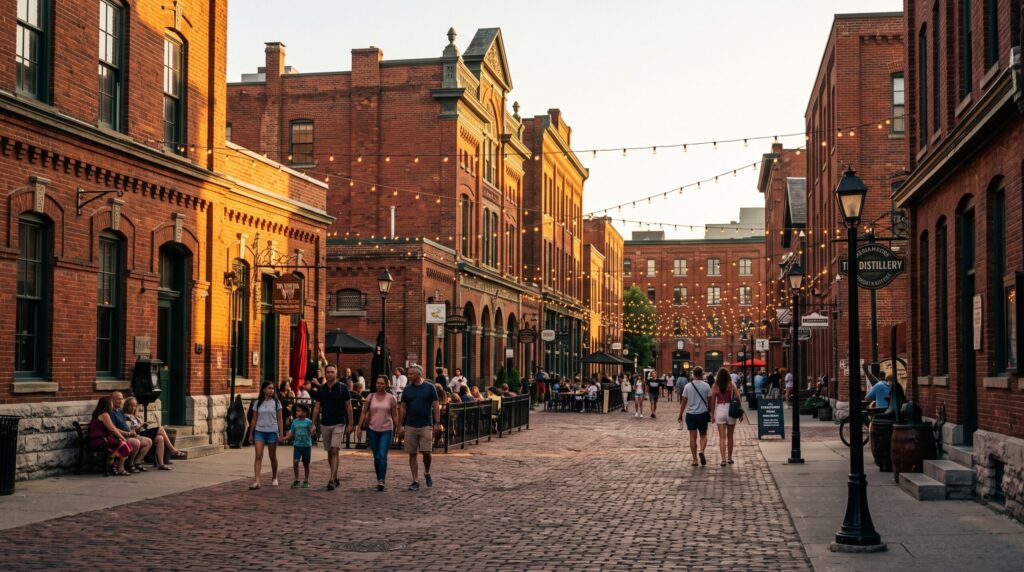
Distillery Historic District
This was the Gooderham & Worts distillery, founded in 1832 and, by the mid-1800s, the largest whisky distillery in the British Empire. Production stopped in 1990; the Victorian industrial buildings sat mostly unused for years, and redevelopment turned the whole complex pedestrian-only in the early 2000s. Under its heritage designation, it’s now North America’s largest collection of Victorian-era industrial architecture. That scale sets it apart from a generic shopping block. More than 40 heritage buildings, cobblestone lanes, and enough brick make the golden-hour light worth chasing with a camera.
Go late afternoon into evening, when the crowds thin and the light does its best work on the brick. The district runs seasonal markets, including a well-known Christmas market in winter, so check its own calendar if your trip falls late in the year.
Kensington Market and Chinatown
Kensington began in the early 20th century as a Jewish immigrant market district, with families selling goods from their own front porches. That improvised, street-level character survived even as the neighbourhood’s population turned over several times. Now it’s one of the most visibly multicultural few blocks in the country: a tight grid of vintage shops, produce stalls, record stores, and murals that change from one block to the next. Chinatown runs along Spadina Avenue and Dundas Street West right beside it, adding bakeries, herbalists, and noodle counters.
Walk both without a plan. Eat in small amounts as you go instead of committing to one sit-down meal. Kensington goes car-free for Pedestrian Sundays on select dates through the warmer months, which is worth checking if you want the street at its loosest.

Graffiti Alley (Rush Lane)
Officially it’s Rush Lane, a stretch of laneway about a kilometre long running parallel to Queen Street West, just south of it, between Spadina Avenue and Portland Street in the Fashion District. Lonely Planet has called it the city’s most popular spot to see street art, and the density of work backs that up. Layered, ever-changing murals cover nearly every surface for three full blocks. It got wider recognition as the regular backdrop for Rick Mercer’s televised “rant” segments. It isn’t a legally sanctioned wall, which is part of why the art turns over so often. It’s free and always open, because it’s simply a public laneway.
Fort York National Historic Site
Fort York stands where British and Canadian forces met American troops in the Battle of York in April 1813. The defeat ended with the fort’s gunpowder magazine deliberately blown up and much of the town burned, an event often cited as context for the British burning of Washington the following year. The fort was rebuilt afterwards, and it now holds Canada’s largest collection of original structures from the War of 1812 era: eight buildings inside earthwork walls. Check the fort’s own site for admission and current hours, which vary by season. Allow two to four hours if you take one of the hourly guided tours, and take one. Past visitors consistently rate the tours above wandering alone.
Casa Loma
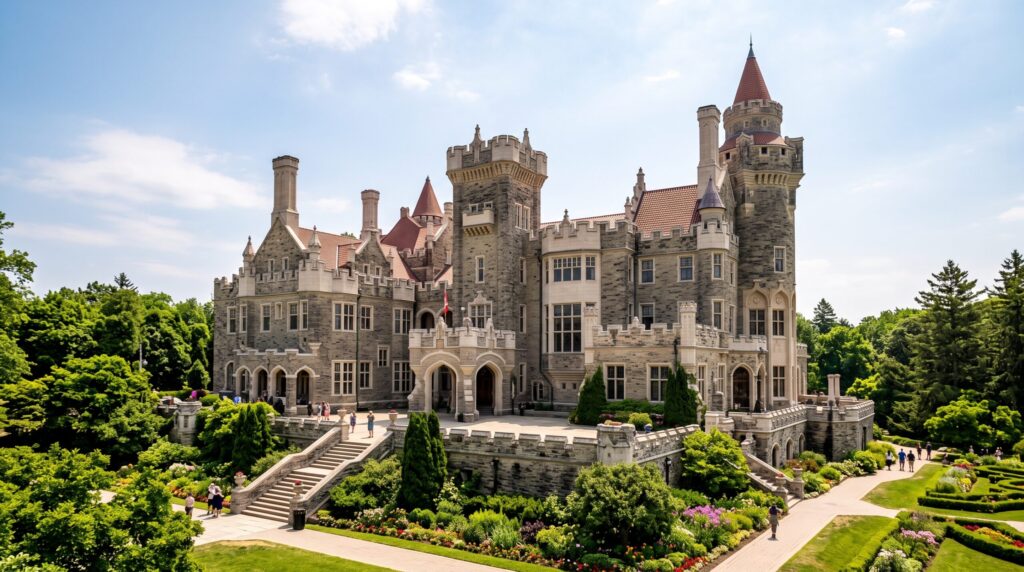
Casa Loma is a Gothic Revival castle on a hill above Davenport Road, built between 1911 and 1914 for the financier Sir Henry Pellatt, who lost it to unpaid property taxes in the 1920s. Touring runs daily from 9:30 a.m. to 5 p.m., with last admission at 4:30 p.m. Your timed ticket includes a documentary on Pellatt and a free audio guide app. Kids tend to remember the 800-foot tunnel leading to the Carriage Room, Potting Shed and Stables. You reach the towers by a spiral staircase, and the Scottish Tower closes at 3 p.m. Wednesday to Friday and 1 p.m. on weekends, so go early. Strollers aren’t recommended because of the stairs. To get there by transit, ride the subway to Dupont Station and walk two blocks north on Spadina Avenue, then take the hill or the 110 Baldwin Steps. Onsite parking is $20.
St. Lawrence Hall and Cathedral Church of St. James
The two sit two blocks apart in Old Toronto, and they’re best folded into a St. Lawrence Market walk rather than visited alone. St. Lawrence Hall, built in 1850 and 1851, served as the city’s de facto town hall for roughly a decade and hosted abolitionist meetings when Toronto was a terminus of the Underground Railroad. The Cathedral Church of St. James traces its congregation to 1797, which makes it the city’s oldest. The current stone building dates to 1850–53, after a fire destroyed an earlier one, and its spire, finished in 1874, was for a time the tallest in North America. You can see both from outside, and the cathedral welcomes visitors during open hours.
University of Toronto campus
The downtown St. George campus is a working university, not a sightseeing attraction, and that’s the appeal. You can walk through real Gothic Revival quads and past University College’s 1859 stonework with no ticket and no guide. It sits between the ROM, the Gardiner and the AGO, so it makes a natural connector if you’re already moving between those three on foot.
Toronto neighbourhoods beyond downtown
Kensington Market, Chinatown and the Distillery District are covered above because they double as attractions. A few more neighbourhoods reward a slow walk if you have the time.
|
Neighbourhood |
Where |
Time needed |
Daytime or evening |
|
Little Italy |
College Street west of Bathurst |
2 to 3 hours |
Evening |
|
Yorkville |
Near the ROM |
1 to 2 hours |
Daytime |
|
Queen West |
Along the Queen streetcar line |
Half day |
Daytime into evening |
|
The Beaches |
East end, on the lake |
Half day |
Daytime |
|
Liberty Village |
Near BMO Field |
1 to 2 hours |
Evening, or before a match |
|
Yorkdale Shopping Centre |
North York, on the subway at Yorkdale station |
2 to 4 hours |
Daytime |
Little Italy, on College Street west of Bathurst, is patios, cafes and long dinners, with no sights to tick off. Go around 7 p.m. on a warm evening and let the street do the work.
Yorkville, near the ROM, is where Toronto shops and eats at the high end: tidy streets, expensive boutiques, good people-watching, and no obligation to buy anything.
Queen West runs independent shops, vintage stores and galleries along the streetcar line. A day of poking around with no fixed plan suits it.
The Beaches, in the east end, has a lakeside boardwalk and a small-town main street. The streetcar reaches it, but the ride is long enough that you should treat the trip as a half-day outing.
Liberty Village is a former industrial district now full of converted warehouses, breweries and restaurants. It sits close to BMO Field and works well as a pre-game stop before a Toronto FC match.
If shopping is the point of the day and not a side effect of wandering, Yorkdale Shopping Centre in North York is the one to know. It opened in 1964 and has grown to roughly 2 million square feet and more than 270 stores, including the country’s largest concentration of luxury brands, from Louis Vuitton to Tiffany & Co. It sits directly on the subway at Yorkdale station, so it’s an easy stop without a car. Just know it feels like a shopping trip, not a sightseeing one.
What should you eat in Toronto?
Start with a peameal bacon sandwich at St. Lawrence Market, then eat by neighbourhood. Chinatown covers dim sum and noodles, Kensington Market suits small bites, Little Italy suits long patio dinners, and districts such as Greektown, Koreatown, Little India, Little Jamaica and Little Portugal serve their own communities first. In the 2021 census, 46.6 per cent of Toronto residents were born outside Canada, and the food shows it.
|
Craving |
Where to go |
Pairs well with |
|
Peameal bacon sandwich |
St. Lawrence Market, South Market |
Hockey Hall of Fame |
|
Dim sum and noodles |
Chinatown, Spadina Avenue and Dundas Street West |
Art Gallery of Ontario |
|
Small bites on the move |
Kensington Market |
Graffiti Alley |
|
Patio dinner |
Little Italy, College Street west of Bathurst |
An evening walk |
|
Dinner among restored brick |
Distillery District |
A golden hour walk |
|
Pre-game pint |
Liberty Village |
BMO Field |
|
Dinner with a view |
CN Tower dinner reservation |
A sunset slot |
|
Neighbourhood food crawl |
Greektown, Koreatown, Little India, Little Jamaica, Little Portugal |
A free afternoon |
Eat in small amounts as you go instead of committing to one long sit-down meal. Most of these areas are reachable on the TTC, so check How to get around Toronto before you plan the route.
Free things to do
Toronto has a pricey reputation, but what to do in Toronto on a budget is a longer list than most visitors expect. A surprising share costs nothing beyond transit fare.
|
Activity |
When |
Area |
|
Nathan Phillips Square |
All year, rink in winter |
Downtown, City Hall |
|
The Power Plant |
Open most days; check hours |
Harbourfront |
|
The Image Centre |
Check hours |
Near Yonge and Dundas |
|
Riverdale Farm |
Daily, 9 a.m. to 5 p.m. |
Cabbagetown |
|
Allan Gardens Conservatory |
Daily, 10 a.m. to 5 p.m. |
Downtown east |
|
Evergreen Brick Works |
Saturday market 8 a.m. to 1 p.m., trails daily |
Don Valley |
|
High Park |
Daily |
West end |
|
Harbourfront |
Daily |
Queens Quay |
|
Graffiti Alley |
Always open |
Queen West |
|
Doors Open Toronto |
One weekend each May |
Citywide |
|
ROMWalks |
Wednesday evenings and Sunday afternoons, May to October |
Varies by walk |
|
Free Flicks at Harbourfront |
Tuesday evenings, mid-July to early September |
Harbourfront |
|
MOCA Toronto free evening |
First Friday night of the month’s first full weekend, 5 to 9 p.m. |
Junction Triangle |
|
Gardiner Museum free evening |
Wednesdays, 4 to 9 p.m. |
Queen’s Park |
|
Bata Shoe Museum free day |
Sundays |
Bloor and St. George |
|
Aga Khan Museum free evening |
Wednesdays, 4 to 8 p.m. |
North end |
Riverdale Farm
Riverdale Farm is tucked into Cabbagetown at the edge of the Don Valley, a working farm on 7.5 acres with cows, pigs, sheep, goats and chickens in barns linked by walking paths. Entry costs nothing, any day, all year. It started in 1978 on the former site of Toronto’s original zoo, which closed when the modern Toronto Zoo opened across the city. Spring is the best season, when lambs and chicks appear, usually from March through May. It pairs naturally with a walk through Cabbagetown itself, one of the largest continuous stretches of Victorian housing in North America. That walk isn’t covered elsewhere in this guide, so you’ll be exploring on your own.
Allan Gardens Conservatory
Allan Gardens is one of Toronto’s oldest parks. The politician George Allan donated the land in 1858 for public horticultural use. The Palm House at its centre dates to 1910, after an earlier conservatory burned down in 1902. Today six connected greenhouses hold a permanent tropical, desert and seasonal plant collection under more than 16,000 square feet of glass. It’s free, open 365 days a year from 10 a.m. to 5 p.m., and one of the better wet or cold-weather stops, mostly because almost nobody outside the city thinks to look for it. Some sections have been periodically restored, so expect at least part of the complex to be in some stage of repair.
Evergreen Brick Works
This was a working brick quarry and factory from 1889 until operations wound down in the 1980s, and its bricks built a meaningful share of old Toronto, including parts of Casa Loma. The site sat abandoned for years before Evergreen, a non-profit, redeveloped it into trails, public gardens, event space and a well-regarded weekend market, reopening progressively through the 2010s. The Saturday Farmers Market runs 8 a.m. to 1 p.m. year-round, outdoors from May to October and indoors through the colder months, and it’s often cited as the city’s largest. The surrounding Don Valley trails are free and connect to a wider ravine network, so bring real shoes if you plan to walk beyond the market.
Doors Open Toronto
One weekend each May, usually the fourth, the city opens more than 150 buildings that are normally closed to the public or normally charge admission. All of it is free. Past years have included St. Lawrence Market North, the Steam Whistle Brewery roundhouse, church interiors, and private architectural landmarks you can’t otherwise get inside. If your trip falls on Doors Open weekend, build a day around it. The list changes every year, and some sites draw long lines.
ROMWalks
From May to October, the Royal Ontario Museum runs ROMWalks, free volunteer-led walking tours through a different Toronto neighbourhood each outing, covering architecture and local history a guidebook would skip. Walks follow a set schedule, typically Wednesday evenings and Sunday afternoons, and you don’t need to register. Show up at the posted meeting point and look for the group. Past seasons have covered Yorkville, Queen’s Park, Riverdale and the city’s older cemeteries. Check the ROM’s site for this year’s schedule and starting points before planning a day around one.
Free Flicks and outdoor movies
Harbourfront Centre has a long-standing summer tradition of free outdoor film screenings by the lake, typically on Tuesday evenings from mid-July into early September. Other neighbourhood parks, including Christie Pits and Kew Gardens in the Beaches, run their own free or low-cost outdoor movie nights across the same stretch of summer. Schedules shift from year to year, so check listings closer to your travel dates.
Outdoors and nature
Outdoor activities to do in Toronto, Canada start with a shoreline about 46 kilometres long on Lake Ontario, plus ravines and large parks running through the city. The table below shows how to get to each outdoor stop, how long to allow, and the best season to go.
|
Place |
How to get there |
Time needed |
Best season |
|
High Park |
Subway to High Park station |
2 to 4 hours |
Late April to early May for blossoms, or any clear day |
|
Scarborough Bluffs |
Long transit trip east, or a car |
Half day |
Late spring to early autumn, on a clear day |
|
Harbourfront |
Short walk from Union Station |
1 to 2 hours |
Summer evenings |
|
Evergreen Brick Works |
Shuttle from Broadview Station (per the venue), or a walk from Castle Frank Station. Confirm shuttle days |
2 to 3 hours |
Saturday mornings |
|
Toronto Islands |
Ferry from the Jack Layton Ferry Terminal |
Half day to full day |
Summer, or autumn for quiet |
High Park
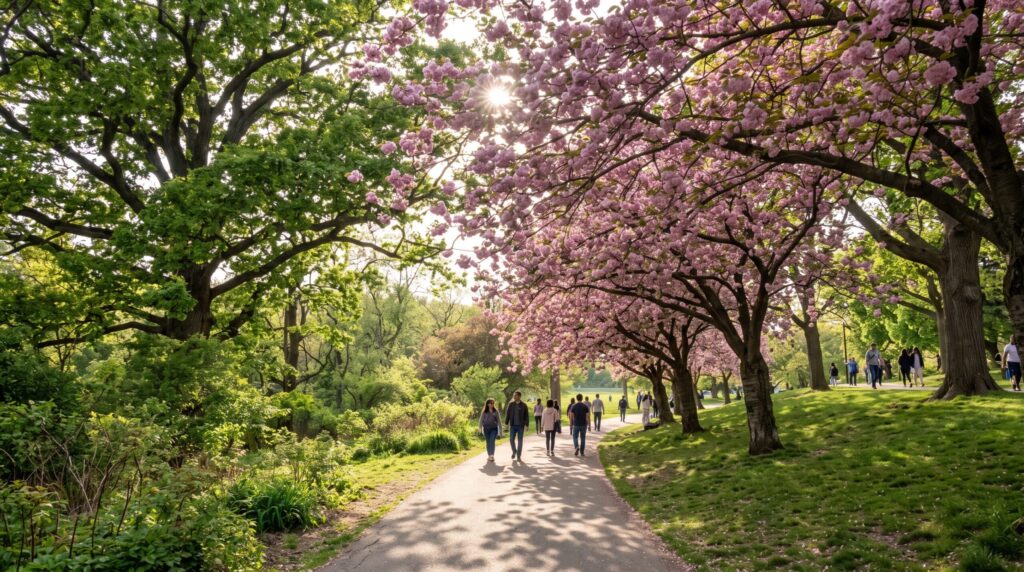
High Park is the city’s largest and most-used green space. The city planner John George Howard donated it to Toronto in 1873 on the condition that it stay free and open to the public, and the city has kept that promise for more than 150 years. It has a pond, a free zoo, playgrounds, and trails through oak savannah, a rare and actively protected ecosystem in this part of Ontario. For a short window each spring, usually late April into early May, it also hosts one of the city’s most-photographed cherry blossom displays. Bloom timing shifts with the weather every year, so check a bloom report before you plan a trip around it.
Scarborough Bluffs
The Bluffs run along the eastern lakeshore, cliffs of layered clay and sand rising to roughly 90 metres above Lake Ontario in places. They were carved over thousands of years and are still eroding, which is why fenced-off sections and warning signs show up along the clifftop. Bluffer’s Park is the usual way down to the water’s edge, with beaches and a marina below the cliffs. It’s a longer transit trip from downtown, so budget half a day. Pick it for a clear day when you want lake views without another ticket booth.
Harbourfront
Harbourfront runs along Queens Quay between the ferry terminal and the CN Tower. It’s a strip of public lakefront with a performance centre and the galleries covered above, redeveloped from industrial shipping land starting in the 1970s and 1980s. It’s free to walk and connects naturally to the tower, the aquarium, and the ferry. Think of it less as a destination and more as the thread that holds a downtown day together.
Toronto Islands
The Toronto Islands are a short ferry ride from downtown and feel like another town: no cars, wide lawns, and a view back at the skyline. Ferries leave from the Jack Layton Ferry Terminal at 9 Queens Quay West, and one ticket covers any island dock and the trip back. Adults pay $9.57 round trip and older adults pay $6.15. Centre Island is the busiest and best for families, with bike rentals and the amusement area. Ward’s Island is quieter, with boardwalks, a calm beach and a small residential community. From mid-October to mid-April, ferries go only to Ward’s Island, and Ward’s is a 35-minute walk from Centre Island. The city says return trips are busiest from 5 to 9 p.m., so if you have a bus to catch that evening, leave early and book a later BoletoXpress departure.

Family attractions
When planning for budget family travel, most of the stuff to do in Toronto with kids works for a mix of ages, but a few stops have limits on height or age or strollers. The table below shows age notes, time needed, and whether you need a car, so you can pick the right mix for your group.
|
Attraction |
Age notes |
Time needed |
Car needed? |
|
Ripley’s Aquarium of Canada |
All ages |
2 to 3 hours |
No |
|
Toronto Zoo |
All ages, strollers and wagons help |
Half day to full day |
No, but the transit trip is long. A car takes about 30 minutes |
|
Riverdale Farm |
All ages, best with young kids |
1 to 2 hours |
No |
|
Little Canada |
Children under 13 need an adult with them |
About 2 hours |
No |
|
Casa Loma |
Kids who like towers and tunnels. Strollers are not recommended |
2 to 3 hours |
No, ride to Dupont Station |
|
Toronto Islands |
All ages |
Half day to full day |
No, take the ferry |
|
Canada’s Wonderland |
Ride height rules apply |
Full day |
Yes, or a long GO and bus combination |
Toronto Zoo
Canada’s largest zoo sits in the Rouge Valley in the city’s east end, about 30 minutes from downtown by car, and it’s genuinely big. More than 10 kilometres of walking trails span seven zoogeographic regions, with roughly 5,000 animals and 450-plus species. The giant pandas, which were flown in from China in 2013 on a long-term loan, relocated to the Calgary Zoo in 2018 and are no longer at the park. The African Rainforest Pavilion is another highlight and is home to the world’s largest indoor gorilla exhibit. In summer, a hop-on, hop-off Zoomobile covers the distance between regions, which is worth knowing before you commit to the whole loop on foot with small kids. Adult admission runs roughly $25 to $35 depending on the date and season, so check the zoo’s own site for your specific day. It’s one of the five picks available on the Toronto CityPASS.
Little Canada
Little Canada opened in 2021 in a former warehouse at Dundas and Jarvis. It’s a 45,000-square-foot miniature-world attraction, with tiny, highly detailed recreations of Canadian cities and landscapes: a scale Toronto skyline, Niagara Falls and, more recently, a West Coast expansion. More than 40,000 miniature figures live there alongside moving trains, cars and water features. Public polls have voted it Toronto’s top indoor attraction for several years running. It takes about two hours to see properly, and children under 13 need adult supervision throughout. Check the official site for current admission and hours, which have shifted a few times since opening.
Canada's Wonderland
Ontario’s main amusement park is in Vaughan, about 30 to 45 minutes north of downtown by car, or reachable by a combination of GO Transit, TTC and York Region Transit if you don’t have one. It operates seasonally, generally daily from May through early September, then weekends into October for Halloween Haunt, with a separate WinterFest ticket in the colder months. The park has more than 200 rides, including roller coasters such as Leviathan and the record-setting dive coaster Yukon Striker, plus Splash Works, a 20-acre water park included with regular admission in warmer months. Treat this as a full-day commitment, not a half-day add-on. Plan your Toronto schedule around it and don’t try to combine it with anything downtown the same day.
Romantic Toronto
Couples get a different version of this city, with fewer tickets and more time to slow down. A sunset sail on the Tall Ship Kajama is the classic pick. The 165-foot three-masted schooner has sailed Toronto Harbour since the 1990s, running two-hour day and sunset cruises from a slip at Harbourfront behind the Power Plant gallery. The boat has a licensed bar on board, and you can help the crew raise the sails if you want. Adult tickets run around $42 for a standard sail, and more for themed evening cruises. Book directly on the operator’s site, since the schedule for the following season isn’t finalised until late March and early bookings can shift.
For a quieter evening, the Distillery District at golden hour is hard to beat, followed by dinner in one of its restored brick buildings. The Gardiner Museum’s free Wednesday evening hours empty out noticeably once the after-work crowd clears, and the AGO on a weekday evening gives you the same unhurried, half-empty gallery feel. For a bigger night, book a CN Tower dinner reservation, which turns the view into the whole evening instead of a twenty-minute stop.
Weekend in Toronto
How to spend 1 day in Toronto
Morning: St. Lawrence Market for a peameal bacon sandwich and a walk through the stalls. Afternoon: the CN Tower and Ripley’s Aquarium, booked together as the Sea the Sky combination ticket. Evening: a streetcar east to the Distillery District for dinner among the brick. If your one day lands on a Monday, swap the market for a Harbourfront walk, since the market is closed.
How to spend 2 days in Toronto
Day one as above. Day two: Casa Loma first thing, while the towers are open and the stairs are still clear of crowds, then the ROM or the AGO, then an unhurried walk through Kensington Market and Chinatown with dinner there. On a wet day, swap Casa Loma for the Hockey Hall of Fame, which is indoors and downtown.
How to spend 3 days in Toronto
Days one and two as above. Day three: take the ferry to the Toronto Islands, rent a bike on arrival if the season allows, then head back downtown before the 5 to 9 p.m. return rush. In the evening, catch a game if the schedule allows, or take a slower walk through Queen West or Little Italy.
Summer in Toronto
Summer is when the Toronto Islands, Harbourfront and the city’s patios make the most sense, and when baseball is in season at Rogers Centre. Book CN Tower evening slots early, because they fill first in warm weather. Free Flicks at Harbourfront runs through the hottest stretch of the season, and Kensington Market’s Pedestrian Sundays fall in the same window. Pride Week lands in late June, and Caribana, the Caribbean festival centred on Lake Shore Boulevard, runs from mid-July to early August. Add one museum day for when the heat wears you down. And give the Toronto Islands a full day of their own, since they’re the best single day of the season.
Winter in Toronto
Like many major winter events in the US and Canada, the best things to do in Toronto in winter mostly move indoors with one big exception. Skating at Nathan Phillips Square is still the city’s best free cold weather tradition. Past that, the ROM, the AGO, the Gardiner, the Hockey Hall of Fame and the Distillery District (which runs its own seasonal winter market) carry the season. Hockey and basketball are both in full swing, so a game makes a strong evening option. Dress in real layers, and lean on transit instead of walking long outdoor stretches. Downtown also has the PATH, billed as the world’s largest underground shopping complex, which is handy when it is below zero outside.
Day trips
Looking for things to do around Toronto? It makes a reasonable base for trips outside the city when you have a spare day.
|
Trip |
Travel time |
Car needed? |
Time to allow |
|
Niagara Falls |
About 90 minutes by road without traffic |
No, check GO Transit and bus options |
Full day |
|
Niagara-on-the-Lake |
A little past the falls |
Easier with a car |
Full day |
|
Hamilton waterfalls |
About 1 hour |
Easier with a car |
Half day to full day |
|
Prince Edward County |
2.5 to 3 hours |
Yes |
Overnight |
|
McMichael Canadian Art Collection |
Temporarily closed until 2029 |
N/A |
Exclude from itinerary |
|
Canada’s Wonderland |
30 to 45 minutes north |
Easier with a car |
Full day |
Niagara Falls is about 90 minutes by road without traffic, and it’s the obvious choice for good reason. Check GO Transit or bus options if you don’t have a car.
Niagara-on-the-Lake sits a little farther past the falls and is calmer, with a wine region built up around it. It suits a couple better than a family with young kids.
Hamilton’s waterfalls, about an hour out, put you in a city with dozens of named waterfalls inside its own limits. Some conservation areas require reserved entry, so check ahead.
Prince Edward County, two and a half to three hours out, is really an overnight trip rather than a day trip. Wineries, beaches and small towns are the point.
The McMichael Canadian Art Collection is temporarily closed to the public until 2029 for a landmark facility expansion, so skip it on this trip.
Don’t stack a day trip on top of a full slate of downtown attractions. Give the day trip the whole day.
Is the Toronto CityPASS worth buying?
It depends on how many paid stops you actually want. The pass includes the CN Tower and Ripley’s Aquarium of Canada. You then choose three more from the Royal Ontario Museum, City Cruises Toronto (seasonal, April to October), Casa Loma, the Toronto Zoo and the Art Gallery of Ontario. You get nine days to use it, so confirm with CityPASS when the clock starts. Adults pay $134.96 plus HST, for about $152.50. The pass lists a $217 value, and that’s where the up-to-38 % savings figure comes from.
The math is what decides it. The tower and aquarium are already sold together as a Sea the Sky ticket for $79 (adult, online). So the pass costs about $55.96 more than Sea the Sky, and for that money you get three more stops. The table below shows the math step by step.
|
Step |
Amount |
|
Sea the Sky ticket, tower and Ripley’s |
$79.00 |
|
CityPASS adult price before tax |
$134.96 |
|
Extra cost of the pass over Sea the Sky |
$55.96 |
|
Effective price of each of your three extra picks |
about $18.65 |
If the three extra stops you want would cost more than $55.96 at the gate, the pass wins. Compare on the same footing for tax, since the pass is quoted before HST. If you only want one or two extras, buy Sea the Sky and pay for the extras separately.
CityPASS or pay as you go? Choose the pass if your list is the tower, the aquarium and three of the museums, the castle or the zoo. Pay as you go if all you want is the tower and some free wandering. The free stops in this guide, like the Distillery District, Kensington Market, and Graffiti Alley, don’t count toward the pass, so a trip built around them wastes it.
There are two catches. City Cruises runs April to October, so October is your last chance to use that pick; if your dates run later, choose a year-round stop. And children ages 4 to 12 have their own CityPASS price, so total up your group before you buy.
Our pick: the pass is worth it for a first trip of three or more days with a mix of museum and castle interests. It’s a poor buy for a two-stop visit.
What a Toronto day actually costs
Here are a few sample days, built only from prices we could verify, excluding food and lodging.
The free day. A TTC day pass at $13.50, plus Riverdale Farm, Allan Gardens, Graffiti Alley and a walk through the Distillery District, all free. That’s $13.50 per adult before you eat, and a full day.
The classic day. The Sea the Sky combination ticket for the CN Tower and Ripley’s Aquarium is $79, plus a TTC day pass for $13.50, for $92.50 per adult. Add a free lunch stop at St. Lawrence Market and a free evening walk through the Distillery District.
The big day. The CN Tower with The Top at $59, a Toronto Islands ferry round trip at $9.57, and a TTC day pass at $13.50 comes to $82.07 before Casa Loma or the zoo, whose current prices you should check directly.
Transit and the ferry both cost less than a single attraction ticket. The free stops in this guide cover more of a trip than most visitors expect.
How to get around Toronto
The TTC runs Toronto’s transit. A PRESTO ticket costs $3.35 for one ride, a two-ride ticket is $6.70, and a day pass is $13.50. Tapping a PRESTO card or an eligible debit or credit card brings the adult fare down slightly to $3.30. Either way, you get a two-hour transfer window, so a short side errand on the way to your main stop won’t cost you a second fare. Children 12 and under ride free.
The day pass pays for itself on the fifth ride at $13.50. Four rides on a tapped card come to $13.20, which is close enough that you should count your planned trips before deciding. Casa Loma, the ROM, the ferry terminal and nearly everything else downtown in this guide is reachable without a car. Canada’s Wonderland, the Scarborough Bluffs and the McMichael all need a car, a tour transfer, or some patience with a longer transit combination.
How to get to Toronto without driving
Most visitors from nearby cities find that taking reliable bus trips is the simplest way in. You step off downtown, and the subway and streetcar network starts right there. Using online bus ticket booking through BoletoXpress lets you compare fares to Toronto from multiple carriers in one place and choose a departure time that fits your plans. Book early for a Friday evening arrival or a Sunday night departure, since both fill up. Check exactly where your bus drops you. Union Station Bus Terminal is the most central option, but some carriers use other stops. If you’re leaving the same way, book your return ticket before you pack.
Frequently asked questions
What is the best thing to do in Toronto?
The CN Tower is the best-known stop and worth it on a clear day. Our favourite way to spend a full day, though, is a slower one: Kensington Market, Chinatown and the Distillery District, with no ticket required for any of it.
How many days do you need in Toronto?
Two days cover the core attractions if you are wondering what to do in Toronto, Canada on a short visit. Three days let you add the islands or a day built around a neighbourhood. A fourth day is best spent on a trip out of the city.
Is Toronto worth visiting?
Yes. It combines a climbable skyline, a real lakefront, one of the deepest museum scenes in Canada, and some of the country’s best neighbourhood food. Most things to do in Toronto, CA, do not require a car.
Is the CN Tower worth it?
On a clear day, yes. A hazy one erases the point of the view. Skip The Top unless the extra height specifically matters to you.
Is the Toronto CityPASS worth it?
It pays off if your list includes the CN Tower, Ripley’s and two or three more of the ROM, Casa Loma, the AGO, City Cruises or the zoo. For a two-stop visit, it’s a poor deal next to the standalone Sea the Sky ticket.
Can you do Toronto without a car?
Yes, for nearly everything downtown. Canada’s Wonderland, the Scarborough Bluffs and the McMichael Collection are the main exceptions.
Are the Toronto Islands open in October?
Yes, but from mid-October to mid-April, ferries run only to Ward’s Island. Ward’s operates year-round and is a 35-minute walk from Centre Island.
What is closed on Mondays?
St. Lawrence Market. Check any other stop individually before building a Monday itinerary around it.
Is the Ontario Science Centre open?
Not at its original Don Mills Road building, which has been closed since mid-2024 over structural concerns. An interim location opened at Harbourfront Centre in summer 2026 while the province works out a longer-term plan, so check current status and hours before including it in your trip.
How much does the TTC cost?
A PRESTO ticket costs $3.35 for one ride, $6.70 for two rides, and $13.50 for a day pass. Tapping a PRESTO card or eligible card costs $3.30 for an adult. Children 12 and under ride free.
What is the weather like in Toronto?
Toronto has warm, humid summers with highs around 27°C in July and cold, snowy winters with January lows near minus 7°C. It receives about 823 mm of precipitation a year.
What is the best time to visit Toronto?
Late May to June and September are the easiest months, with highs between 19°C and 24°C. Winter suits skating and museum days.
What food is Toronto known for?
The peameal bacon sandwich at St. Lawrence Market is the signature dish. Beyond that, Toronto is best eaten by neighbourhood, from Chinatown dim sum to Greektown, Koreatown and Little India.
Before you go
Check the CN Tower’s hours if your visit falls on October 8 or 20. Check the ferry schedule if you’re travelling after mid-October, since service narrows to Ward’s Island only. Confirm the Ontario Science Centre’s current status before planning around it. Decide on the CityPASS before buying your first individual ticket, not after. Compare bus fares on BoletoXpress for the trip in, and book your return at the same time. Prices, hours, and seasons change, so confirm with each venue directly before you pick your things to do in Toronto.
-
 Author: Roberto GarciaView all posts
I am a Digital Transformation Leader and travel technology professional based in San Antonio, Texas. With over 20 years of experience in transportation systems, digital platforms, and customer-focused technology solutions, I help travelers discover secure, affordable, and efficient bus routes across the USA and Mexico. At BoletoXpress, I write and review travel guides covering cross-border bus travel, FIFA World Cup 2026 transportation, route planning, and affordable travel options for diaspora and international passengers. My expertise spans travel operations, mobility technology, digital booking systems, and modern transportation solutions designed to improve the passenger experience.
Follow on - LinkedIn